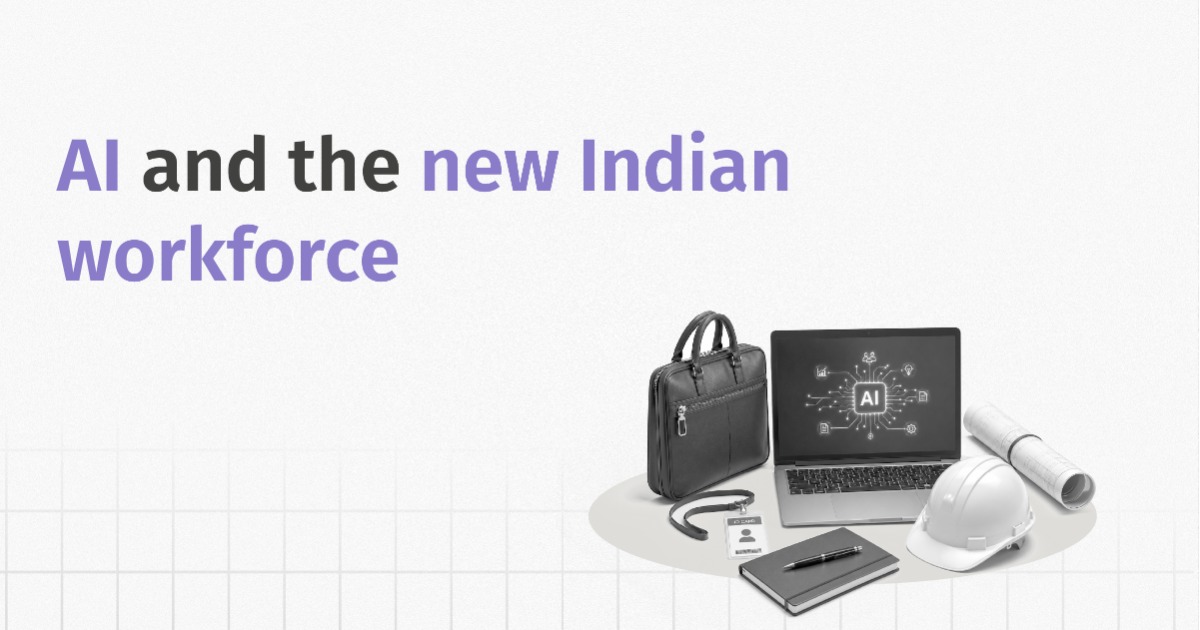
For over two centuries, technological revolutions replaced human muscle. Steam engine displaced manual labour, electricity transformed manufacturing, and computers automated calculation. AI is different in kind. For the first time, technology automates cognition, the writing, analysis, coding, and judgment at the centre of office work. That matters more for India than almost anywhere, because the jobs AI touches first are the ones that built its urban middle class over the last two decades.
India's economy runs on knowledge workers, software engineers, analysts, consultants, and business-process professionals. These sectors employ well over 50 lakh people in IT services alone, created millions of high-paying jobs, and anchored a decade of urban consumption. They are also among the most exposed to generative and agentic AI, which is why this lands on advisors twice over, through the careers of the clients who work in them, and through the consumption and credit their incomes drive.
We treat AI here as an economic force reshaping India's labour market, not a technology trend. The global backdrop frames the stakes.
| Metric | Figure |
|---|---|
| New roles created by 2030 | About 170 million |
| Roles displaced by 2030 | About 92 million |
| Net new roles | About 78 million |
| Workers needing reskilling by 2030 | 59% of the global workforce |
| Of those, at medium-term redundancy risk | About 120 million |
| Employers prioritising upskilling | 85% |
| Employers planning AI-driven headcount cuts | 41% |
AI Automates Tasks Before It Automates Jobs
Every technological wave arrives with fears of mass unemployment, usually overstated but rarely baseless. ATMs did not replace bank tellers; they changed the role. Computers did not replace accountants; they transformed accounting. AI follows the pattern, automating tasks inside occupations rather than erasing them.
Consider a financial analyst. The work involves gathering data, cleaning spreadsheets, building slides, and interpreting results. AI already does much of the first three in minutes, while human judgment still decides what the numbers mean. The IMF estimates nearly 40% of jobs globally are exposed to AI, but exposure is not replacement, and AI often augments the worker rather than substituting for them.
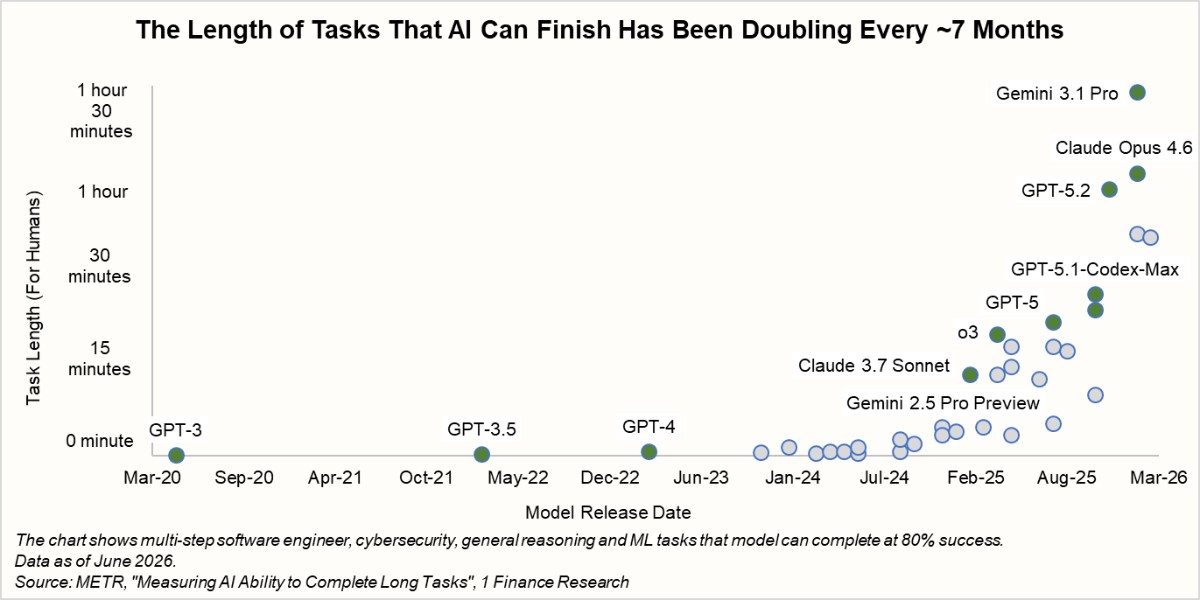
What changes is the labour intensity of output. METR, an AI evaluation group, finds the length of tasks AI can complete autonomously has doubled roughly every seven months for six years, reaching work that takes a skilled human 20 to 30 minutes. As that horizon extends, employers deliver the same output with fewer people. NITI Aayog estimates over 60% of India's formal-sector jobs are exposed to automation by 2030, with IT and business-process work most of all.
The Jobs Most Exposed Are the Ones That Start Careers
Exposure is heaviest at the entry level, because routine, rules-based work is exactly what juniors used to do. Freshers are now just 13% of India's active tech openings, and the under-30 share at Infosys has slid to 51% from 60% in three years, per CLSA. Even the largest employers are shrinking at the base. TCS cut more than 23,000 roles in FY26 as it moved to an AI-first delivery model. The top Indian IT firms exited an estimated 3,400 mid-tier engineers in May and June 2026 alone through performance-based releases, part of a global tech wave that crossed 1.6 lakh cuts in the first half of 2026, with AI now named as the driver rather than a macro slowdown.
Recommended for you
Readers also explored

Currency in Circulation: How Much Money Exists in the World?
 9 min read
India's IT Sector Outlook for FY2026
8 min read
The exposure is not unique to India. The World Economic Forum finds that more than one in three young workers globally are in occupations with medium to high exposure to AI-driven task change. The distinctive twist is what employers now want at the gate. PwC finds the most AI-exposed junior roles are seven times more likely than the least exposed to demand traditionally senior skills such as leadership.
The result is a catch. The routine tasks that once let a fresher learn on the job are the very ones AI now handles, so entry roles increasingly ask for judgment and experience the fresher has had no chance to build. The bottom rung of the ladder is being pulled up just as new graduates reach for it.
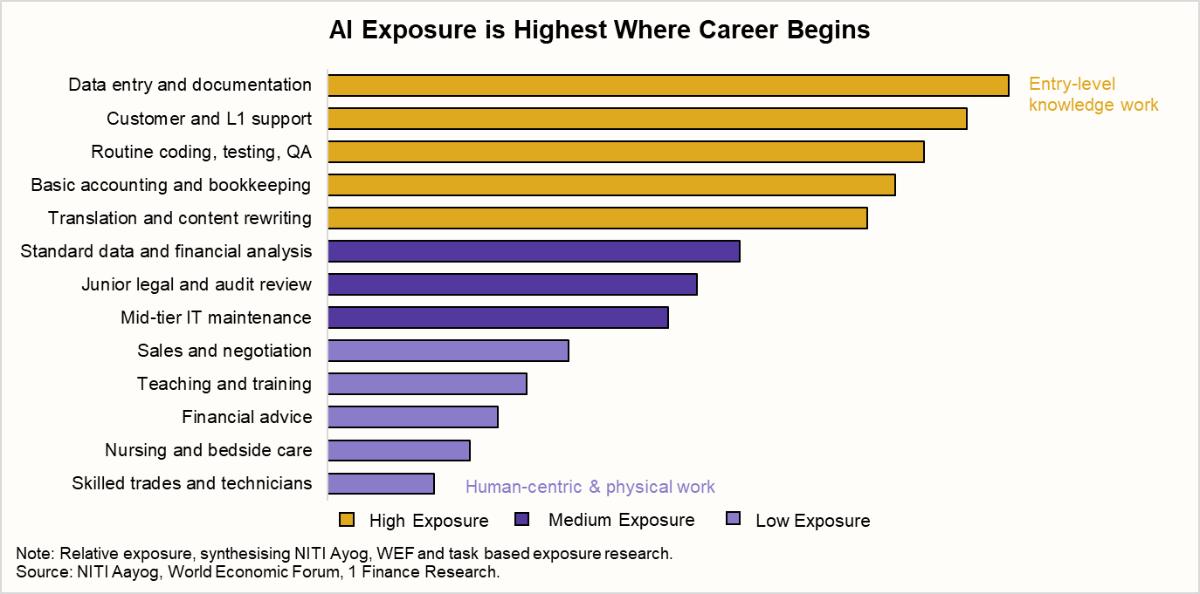
More enduring occupations are built on interpersonal trust, creativity, negotiation, physical presence, or complex judgment, such as financial advisors, doctors, teachers, sales professionals, nurses, electricians, and skilled technicians. The AI era inverts an old assumption. Earlier industrial waves automated blue-collar work first, while this one falls hardest on office-based knowledge work.
GCCs Are the Bright Spot, but They Hire a Different Worker
The demand has not vanished. It has moved. Global Capability Centres, the in-house offshore units multinationals run in India, employ about 2.36 million people directly and anchor a footprint of some 10.4 million jobs once suppliers and worker spending are counted. They generated an estimated $68 billion in direct gross value added last year, equal to about 2% of India's GDP, and $182 billion once supplier and consumption effects are counted. That contribution is projected to keep climbing, not because GCCs are adding people, but because they are moving into higher-value work; direct GVA is expected to nearly double by 2030 even as headcount growth slows.
Crucially, GCCs added nearly twice the net headcount of the traditional IT firms last year, and pay 12 to 20% above them, rising to 30 to 50% for AI and data talent.
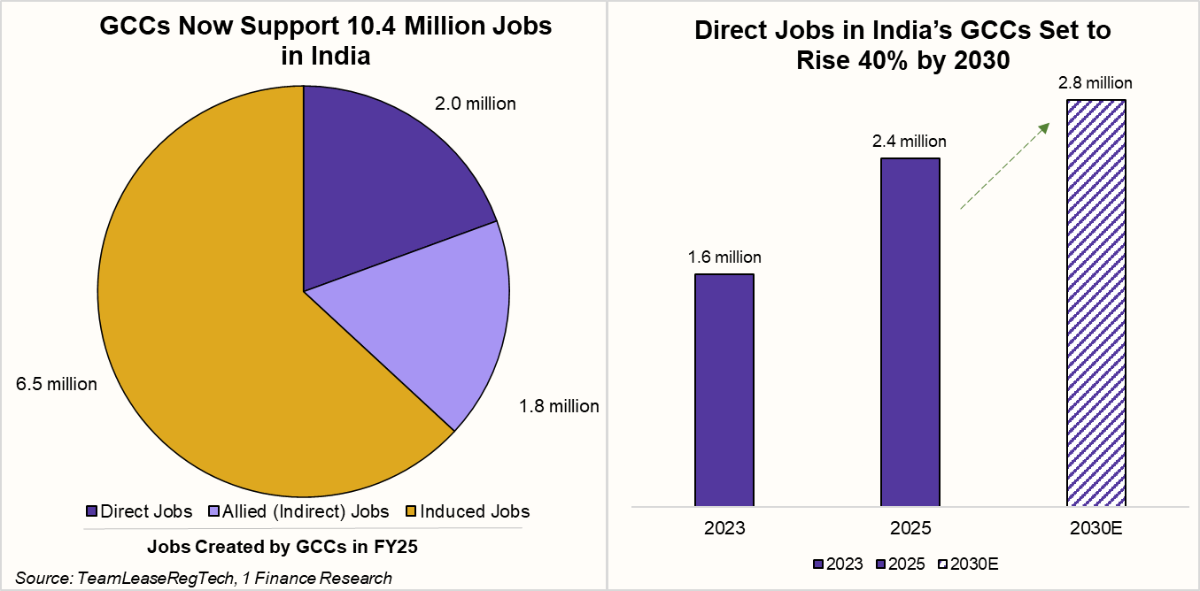
But GCCs are no rescue for the fresher. Their hiring skews to specialists with four to ten years of experience, and 64% of the new roles demand AI, data, or automation skills. Whether the sector grows or shrinks from here is a reskilling question. NITI Aayog's scenarios put tech-services headcount at about 6 million by 2031 if reskilling stalls, or 10 million if it succeeds, and AI talent demand is growing at roughly 25% a year against 15% supply.
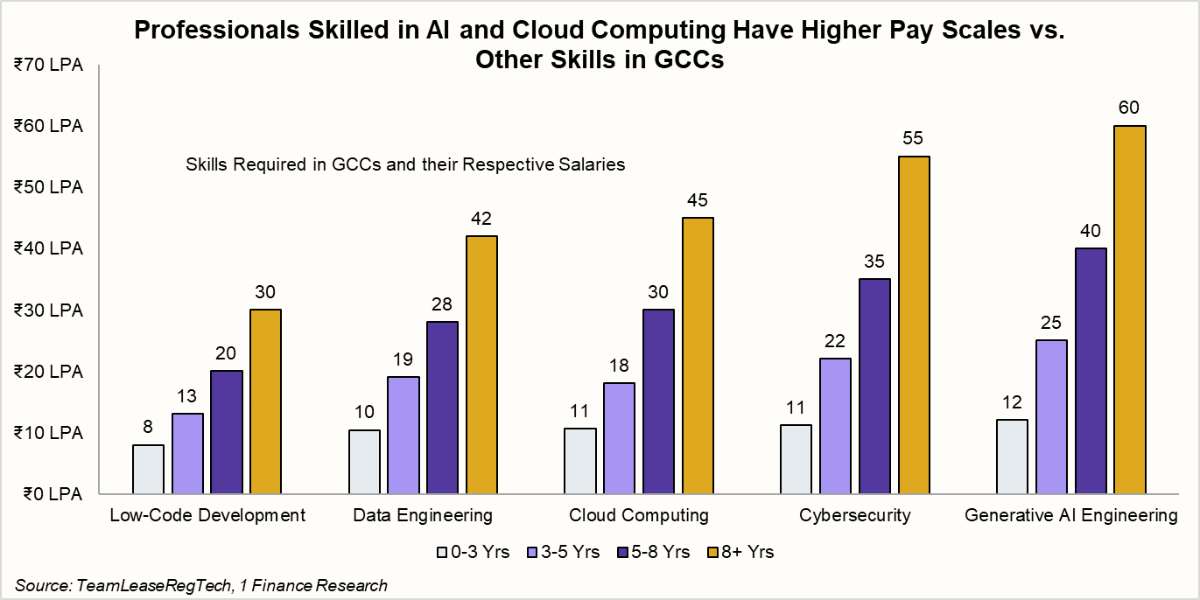
The rise of AI, cybersecurity, and cloud tech has sparked fierce demand for experts. This trend will likely grow as by 2030, the need for skilled workers is expected to far exceed supply.
AI Reaches Beyond the Knowledge Economy
The knowledge workforce is the most visible story, but AI's reach is wider. In manufacturing, it shows up in predictive maintenance and quality inspection; in agriculture, which still employs close to half the workforce, in precision farming and crop and pest monitoring; in healthcare, in diagnostics and paperwork that frees scarce doctors for judgment. The larger point is distributional. NITI Aayog's October 2025 work frames AI as a lever for India's 490 million informal workers, but that dividend is not automatic. Without portable benefits and reskilling that reaches Tier 2 and Tier 3 India, the same technology widens the divide it could close.
| Sector | Automation exposure | Where AI adds value | Job signal |
|---|---|---|---|
| IT and business process | High | AI orchestration, GCC delivery | Entry hiring frozen, specialists bid up |
| BFSI | Medium | Fraud detection, analytics, and personalisation | Shift toward AI and data roles |
| Manufacturing | Medium | Predictive maintenance, quality inspection, supply chain | New oversight and smart-factory roles |
| Healthcare | Medium | Diagnostics, telemedicine, and administrative load | Augments scarce doctors, new tech roles |
| Logistics and retail | Medium | Routing, inventory, scheduling | Routine roles automate, oversight roles grow |
| Agriculture | Low | Precision farming, crop and pest monitoring | Productivity-linked, strongest inclusion upside |
45 May Become the Age Careers Are Reinvented, Not Ended
The most provocative consequence of AI is not unemployment; it is career compression. For decades, seniority meant higher value, because experience carried sharper judgment and larger teams. AI narrows that, since research, drafting, and reporting that once took years to master can now be done with assistance, which prompts firms to question how many managerial layers they still need.
A popular claim needs correcting here. The shift is not seniors swapped for cheaper freshers. The entry rung freezes while a thin layer of AI-skilled specialists, often experienced, is bid up. The real risk is skill obsolescence, which happens to correlate with age in a sector that never retooled its mid-career people.
| Career stage | Pre-AI norm | AI-era shift | Implication |
|---|---|---|---|
| Entry level | Routine tasks that trained the junior | Senior skills expected at the gate | The first rung freezes |
| Mid career | Experience carried a premium | Continuous reskilling required | Obsolescence risk from the forties |
| Senior | Layered management | Flatter teams, portfolio work | Reinvention around 45 |
For many, this arrives earlier than retirement would. People move into consulting, advisory, or fractional roles in their forties rather than their sixties. So the real question is not whether 45 is the new retirement age, but whether it is becoming the age at which a career is rebuilt. The financial catch is simple. If peak earning ends around 45 instead of 60, you lose fifteen of your best saving years while still needing to fund just as long a retirement, since living longer has not changed. Fewer years to save, the same years to pay for.
The Skills on the Rise
The premium is moving from information to judgment. Knowing things is cheap when a model recalls everything; framing the problem and deciding what matters is not. The World Economic Forum finds employers prioritising analytical thinking, resilience, creativity, leadership, and AI literacy.
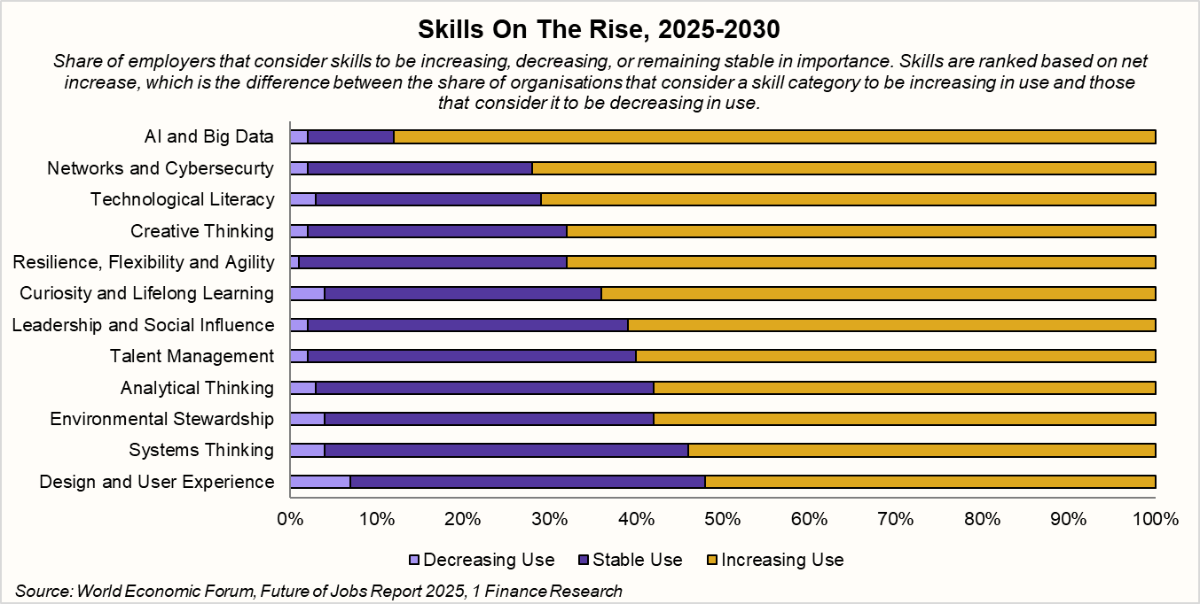
Going forward, people should mix AI into what they already know. Instead of worrying about losing their jobs, they should think of AI as something that can help them grow.
Being skilled in AI, big data, and cybersecurity is going to be very fruitful. Besides that, creative thinking and leadership will be the main attributes to be developed in the future. For Indian workers, constantly being willing to learn is the only way to be able to cope with the ever-changing job requirements.
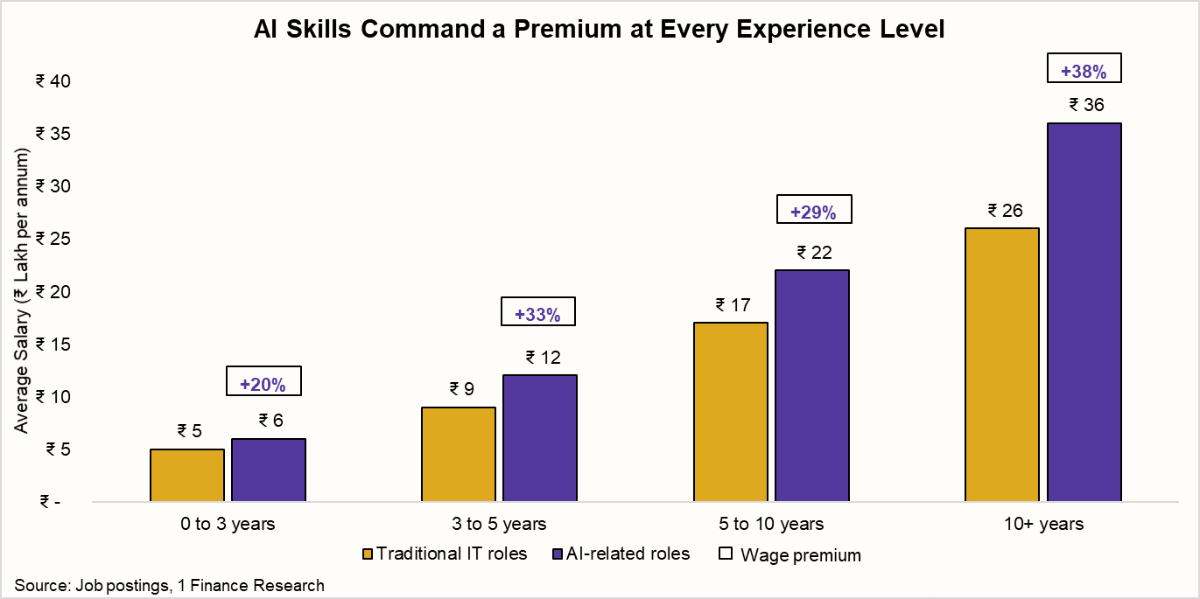
This is where skill relevance becomes crucial. Traditional IT roles struggle to justify rising education costs. In contrast, AI-focused roles show far stronger pay outcomes in India. AI and data roles typically pay 20-40% more at similar experience levels.
The premium grows sharply at senior positions. Experienced AI professionals earn ₹35-70 lakh annually. Meanwhile, many traditional IT roles plateau between ₹23-58 lakh. Thus, salary growth can be faster for AI-related roles, improving the return on investment.
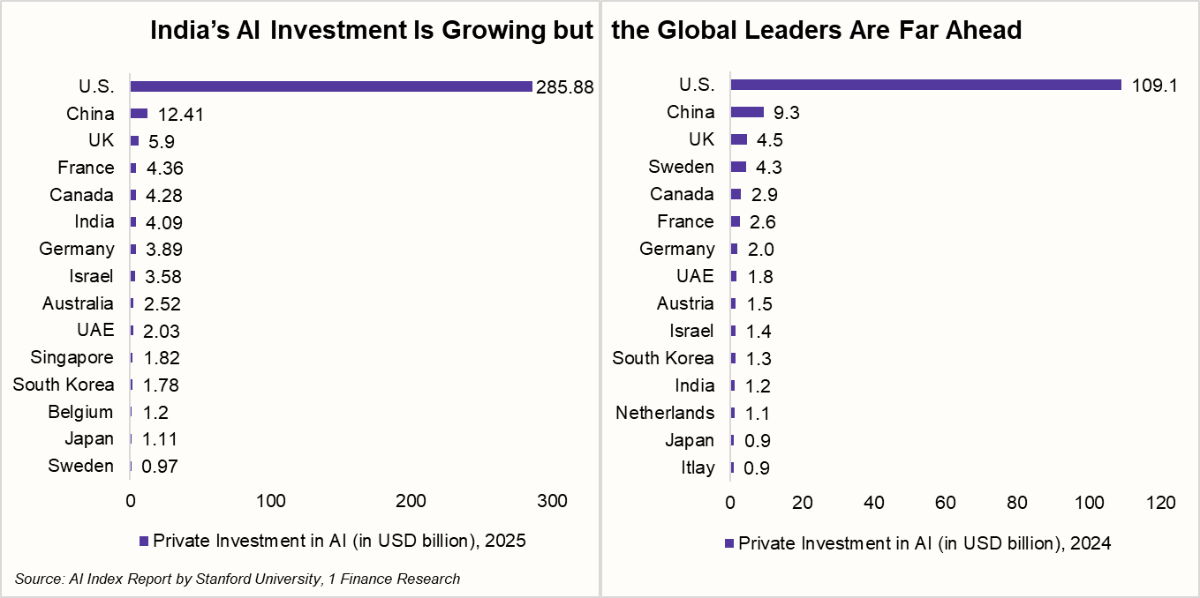
India's problem is a readiness paradox. It leads the world in generative AI course enrolments, over 13 lakh in 2024, yet ranks only 46th on Coursera's AI Maturity Index and 89th of 109 countries on proficiency, and only 30% of its genAI learners are women. India spends about 0.6% of GDP on research and development, against 3.5% in the US and 2.9% in the UK, and drew roughly 4.1 billion dollars of private AI investment in 2025 against 285 billion in the US. Enthusiasm is abundant. Applied capability at scale is not, which is why reskilling has to be continuous rather than a one-time certificate.
The State Is Responding, but Execution Lags
The government is not standing still. The IndiaAI Mission commits ₹10,372 crore over five years, has deployed some 38,000 GPUs at subsidised rates, and funds a FutureSkills pillar that supports 13,500 scholars, alongside data and AI labs in smaller cities. NASSCOM expects India's AI talent pool to double to 1.25 million by 2027. The gap is execution.
India already invests thinly in research, about 0.6% of GDP, against 3.5% in the US and 2.9% in the UK. And even the targeted AI money is not fully deployed: of the IndiaAI Mission's allocation, roughly ₹800 crore of the prior year was actually spent, and the FY27 budget earmarked just ₹1,000 crore more. A low base, underspent, is a hard foundation on which to close a talent gap this wide. Whether reskilling reaches Tier 2 and Tier 3 India and narrows the gender gap in AI learning, where women are only 30% of learners, will decide if the paradox closes.
The Advisor's Playbook
For clients whose income rides on one employer or one automatable skill, the plan needs rewiring. Three habits move from optional to essential.
- Treat reskilling as a recurring line in the plan, since it is what buys career longevity.
- Hold a larger emergency buffer, closer to nine to twelve months of expenses, because career gaps grow more frequent.
- And diversify income, while remembering that consulting or freelance work substitutes for a salary and is not the same as a genuinely passive stream that pays when the client cannot work.
Then two structural moves.
- Decorrelate the portfolio from the client's own career. An IT professional holding IT stocks and employer equity is concentrated three times over on one risk factor.
- Reset the retirement target. Full independence by 45 is near impossible, implying a savings rate close to 58%. A coast corpus, reached by 45 to 47 and left to compound to 60, cuts the required rate to about 40%. Size it on a 3 to 3.5% real withdrawal, not the US 4% rule, since Indian consumer and healthcare inflation runs hotter, and there is no state pension to catch a shortfall. The goal shifts from stopping work at 60 to holding optionality by 45, with a dedicated health corpus built from the thirties.
On the investment side, AI is an opportunity as well as a disruption. Parts of IT services face a structural de-rating that should not be bought as a simple dip. Mass-market urban discretionary already faces an income headwind, with urban consumption growth easing to 4.7% in 2QFY26 from 5.9% and top-city home sales down about 13% where tech hiring concentrates, while premiumisation is better insulated.
The credit channel is where the squeeze becomes visible. Unsecured retail lending, personal loans, cards, and consumption EMIs grew on the strength of steady white-collar pay, and about 44% of borrowers now sit in the near-prime or subprime tiers per the RBI, where repayment is thinnest. It does not take a layoff wave: slower raises, frozen fresher hiring, and longer job gaps are enough to strain repayment, and with no collateral behind these loans, stress surfaces fast as delinquencies. Lenders with a heavy unsecured tilt are the ones to watch.
The productivity wave, meanwhile, supports themes such as cloud, cybersecurity, data centres, and enterprise software. These are themes to research, not recommendations, and none of this is personalised advice.
The Question That Remains
AI will not end work. It will redefine which skills pay, how careers arc, and who adapts fast enough. India holds the talent and the ambition, but converting them depends on reskilling millions and turning productivity gains into broad prosperity rather than a wider divide. The economy has already begun to change. The open question is whether its workforce, and the institutions meant to support it, change with it at the pace required.