You take a home loan with an EMI that fits comfortably into your monthly budget. A few months later, the Reserve Bank of India (RBI) changes the Repo Rate. Soon, you receive a message from your lender: the interest rate on your loan has been revised.
But what happens next? Does your EMI go up? Does your loan become longer? And if the RBI cuts rates instead, how quickly do you actually benefit?
The answer lies in understanding the Repo Rate not just as a number announced by the RBI, but as a rate that can ultimately influence how much you pay on your loan each month and over its entire lifetime.
What Is the Repo Rate?
The Repo Rate is the interest rate at which the Reserve Bank of India (RBI) lends short-term funds to banks against eligible securities. It is one of the RBI's key monetary policy tools for influencing borrowing costs, inflation and economic activity.
When the RBI raises the Repo Rate, borrowing generally becomes more expensive across the economy. When it cuts the rate, borrowing costs can ease. These changes eventually make their way to consumers through interest rates on loans, including home loans.
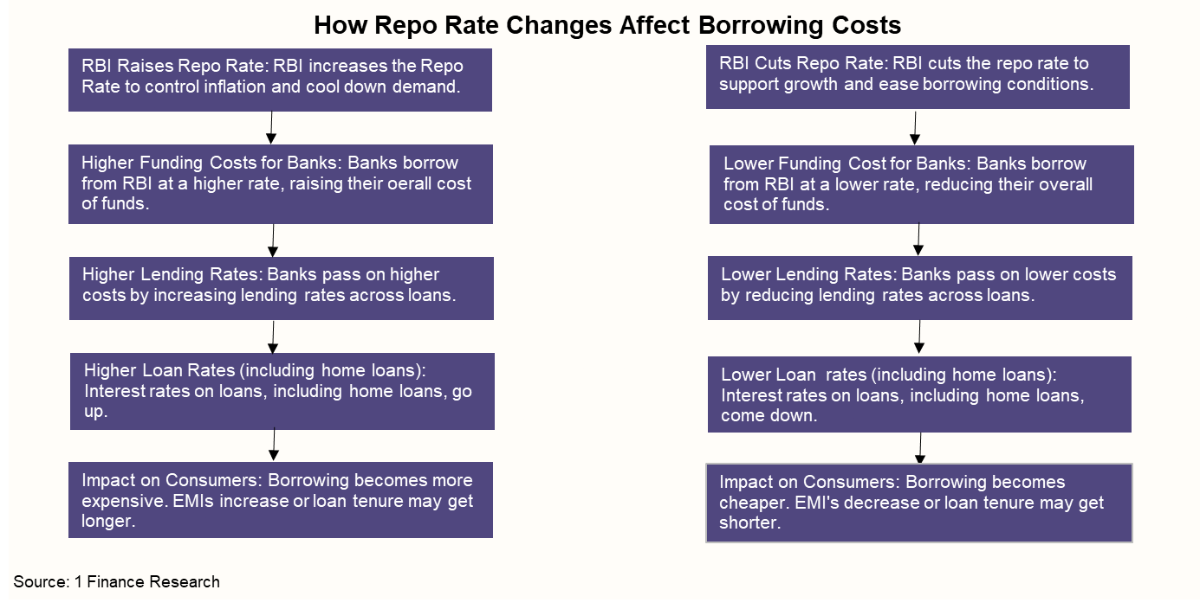
The Repo Rate does not remain constant. It moves through periods of rate hikes, pauses and cuts depending on economic conditions. India's Repo Rate history shows these phases clearly.
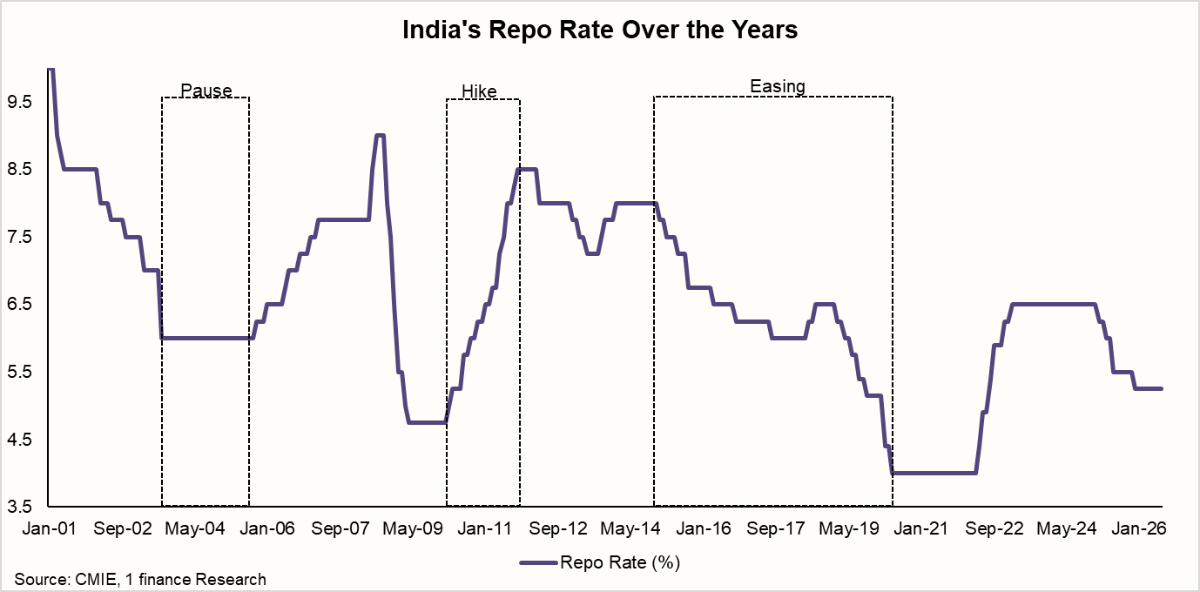
The chart shows that the Repo Rate moves in distinct policy cycles rather than in one direction. During a hiking phase, the RBI raises rates, generally making borrowing more expensive, while an easing phase brings rates down and can reduce borrowing costs. A pause keeps the Repo Rate unchanged as the RBI assesses economic conditions. For borrowers, these shifts matter because changes in the Repo Rate can eventually feed into lending rates and affect the cost of their loans.
Understanding the Repo Rate Cycle
The Repo Rate moves in cycles as the RBI responds to inflation, growth and broader economic conditions. These cycles can broadly be divided into three phases.
| What Each Repo Rate Phase Means for Borrowers | |||
|---|---|---|---|
| Phase | What RBI does | Why it Happens | What it Can Mean for Borrowers |
| Easing | Cuts the Repo Rate | To support economic activity when inflation allows room for lower rates | Lending rates can fall, potentially reducing the EMI or loan tenure on floating-rate loans |
| Pause | Keeps the Repo Rate unchanged | To assess inflation, growth and the impact of earlier policy actions | Loan rates may still change as earlier Repo Rate moves continue to pass through the banking system |
| Hiking | Raises the Repo Rate | Usually to contain inflationary pressures | Lending rates can rise, potentially increasing the EMI, extending the loan tenure, or both |
A single rate change may appear small, but what matters for borrowers is often the cumulative rate cycle. Four consecutive hikes of 25 basis points, for instance, add up to a 100 basis point or 1 percentage point increase. For a long-term home loan, such cumulative changes can have a much larger impact than any single RBI announcement.
How Repo Rate Changes Flow Through the Economy
The Repo Rate sits inside a wider chain. Inflation, RBI policy, lending rates and credit growth all move together over time
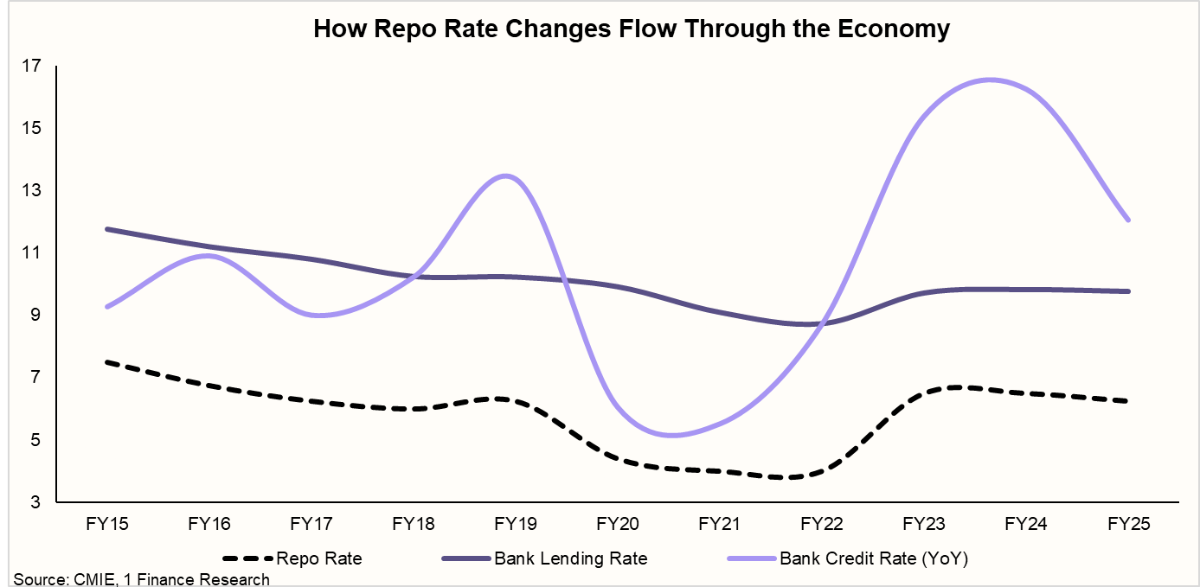
The strongest link is between the Repo Rate and bank lending rates, which generally follow the Repo Rate's direction with a lag. Inflation works the other way. India's retail inflation crossed the RBI's 4% target in June 2026 for the first time in 17 months, and persistent inflation like this can prompt the RBI to hold or raise rates, while easing inflation creates room for cuts.
Credit growth reflects the next stage of transmission. Higher borrowing costs can moderate credit demand, while lower rates can support it, though income, business activity and overall demand also play a role. If you want the household side of this story in more detail, see IMI's blog on India's rising household debt, drawn from the RBI's June 2026 Financial Stability Report.
Inflation and economic conditions lead to the Repo Rate, which shapes lending rates, which shape credit and spending, which in turn feed back into growth and inflation. Your EMI is one visible, household-level outcome of that entire chain.
When the RBI Pauses, Do Lending and Credit Pause Too?
A repo rate pause does not mean lending rates and credit growth stop moving. The three pause periods in India's recent rate history show that monetary policy keeps working through the economy even while the policy rate itself sits still.
| How Lending Rates and Credit Growth Moved During Repo Rate Pauses | |||
|---|---|---|---|
| Component | May 2020 - April 2022 | Feb 2023 - Jan 2025 | Dec 2025 - Present |
| Repo Rate | 4% | 6.50% | 5.25% |
| Lending Rate | 9.76% - 8.72% | 9.67% - 9.87% | 9.06 - 8.96 |
| Credit Rate | 5.52% - 10.28% | 15.89% - 1.72% | 12.42% - 10.25% |
The differences across these three periods are still striking, even with the correction. During the 2020-22 pause, lending rates kept falling while credit growth strengthened. During the 2023-25 pause, lending rates edged higher even with the repo rate frozen at 6.50%, while credit growth slowed sharply as the RBI tightened capital requirements on unsecured lending. In the current pause, both lending rates and credit growth have moderated together.
An unchanged repo rate should never be read as "nothing is changing." Lending rates keep adjusting as earlier policy moves work their way through the banking system, and credit growth keeps responding to demand, liquidity, and regulatory action, independent of what the repo rate itself is doing.
Does Every Repo Rate Really Reach You?
Not evenly, and not at the same speed. The repo rate is set by the RBI, but the interest rate a borrower actually pays is set by their bank, and how much of any repo move gets passed through depends on the loan's benchmark, the bank's cost of funds, its deposit obligations, and the loan's own reset schedule. That's why two borrowers can see different outcomes from the same RBI announcement.
The clearest way to see this is to compare how far a hike travels against how far an equivalent cut travels.
| How Different Interest Rates Respond to Repo Rate Hikes and Cuts | |||||
|---|---|---|---|---|---|
| Rate | What it Represents | Tightening Cycle (Repo Rate +250 bps) | Transmission | Easing Cycle (Repo Rate -100 bps) | Transmission |
| EBLR | Loans directly linked to the RBI repo rate | +250 bps | 100% | −100 bps | 100% |
| 1 - year MCLR (Median) | Loans linked to the bank's own cost of funds | +175 bps | 70% | −10 bps | 10% |
| WALR- Fresh Loans | Average lending rate on newly sanctioned loans | +186 bps | 74% | −26 bps | 26% |
| WALR – Outstanding Loans | Average lending rate on existing loans | +115 bps | 46% | −18 bps | 18% |
| Fresh Deposit Rate | Interest rate offered on new deposits | +259 bps | 104% | −51 bps | 51% |
| Outstanding Deposit Rate | Interest paid on existing deposits | +206 bps | 82% | −2 bps | 2% |
The pattern is asymmetric, and it's the single most useful thing to take from this table. EBLR-linked loans transmit fully in both directions because they're mechanically tied to the repo rate. Everything else transmits hikes faster and more completely than cuts. MCLR loans passed on 70% of the last tightening cycle but only 10% of the easing cycle. Fresh deposit rates rose by more than the repo rate itself during the hike (104% transmission) but fell by barely half the cut. That gap is why banks' funding costs stay sticky on the way down; they're still paying elevated interest on deposits taken during the hiking phase, which limits how fast they can cut lending rates even after the RBI does.
For a borrower, the practical takeaway is this: if your loan is EBLR-linked, you feel every repo move, up or down, in full and fast. If it's MCLR-linked or older, you'll have felt the last hiking cycle almost as sharply as an EBLR borrower, but you should expect any future cut to reach you slowly and only partially.
How Bank Lending Rates Changed During the Repo Rate Pause
A pause doesn't freeze borrowing costs even for a full two years. Between May 2020 and April 2022, with the repo rate held at 4.00% throughout, lending rates kept adjusting across bank groups. Public sector banks saw rates fall from 9.15% to 8.20%. Private sector banks fell further, from 10.81% to 9.62%. Foreign banks saw the sharpest decline, from 9.36% to 7.79%.
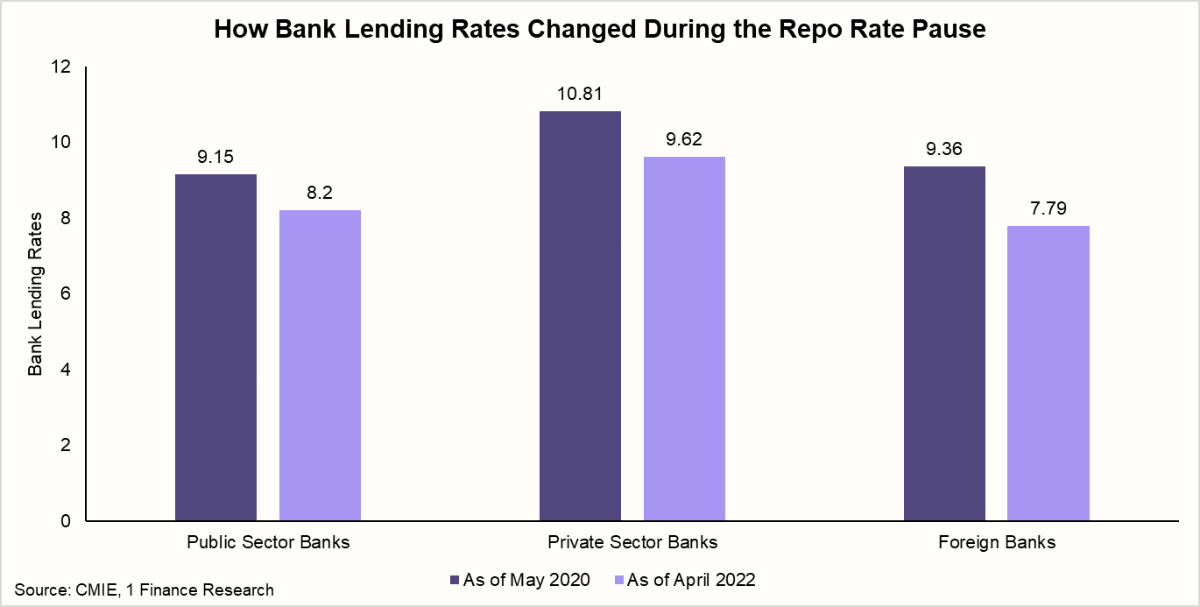
The lesson carries forward to today's pause: previous policy moves, banks' own funding costs, and liquidity conditions keep shaping the rate a borrower actually faces, long after the RBI itself has stopped moving.
How Does the Repo Rate Reach Your Loan?
A Repo Rate change does not directly change your EMI. It first passes through the lending system before reaching your loan.
RBI changes Repo Rate → Lending benchmark changes → Loan rate resets → EMI or tenure changes
For floating-rate loans, the impact depends mainly on the benchmark, the lender's spread, and when the loan rate is due for a reset.
💡Know Your Loan Rate
Loan Interest Rate = Benchmark Rate + Spread
Benchmark is the reference rate to which your loan is linked. Spread is the additional rate charged by the lender.
A Repo Rate change may not reach you immediately. Your loan rate changes according to its reset frequency, creating a lag between the RBI's decision and its impact on your EMI.
For example: If your loan's benchmark rate is 6.5% and your lender charges a 2% spread, your loan interest rate would be:
6.5% + 2% = 8.5%
If the benchmark falls to 6.0% while the spread remains unchanged, your loan rate could fall to 8.0% at the next reset.
This is why a rate change may not affect your EMI immediately. Your loan rate changes according to its reset frequency, creating a lag between a change in the benchmark and its impact on your EMI. |
This is why the same Repo Rate change can affect two borrowers differently, even when both have floating-rate loans.
How Does the Repo Rate Impact Your EMI?
The impact of a Repo Rate change depends first on what type of loan you have. Not every borrower sees the same change.
| How Different Loan Types Respond to Rate Changes | |
|---|---|
| Loan type | Impact of Repo Rate changes |
| Floating-rate loan | Interest rate can change when the benchmark linked to the loan changes |
| Fixed-rate loan | Interest rate generally remains unchanged during the fixed-rate period |
| Hybrid loan | May remain fixed initially and become floating later, depending on the loan terms |
For floating-rate borrowers, a rise in the applicable loan rate can affect the loan in two ways:
| What Happens When Your Loan Interest Rate Changes? | |||
|---|---|---|---|
| Interest Rate Changes | If EMI Is Adjusted | If EMI Is Kept the Same | Overall Impact |
| Rate rises | EMI increases | Loan tenure increases | Total interest cost increases |
| Rate falls | EMI decreases | Loan tenure decreases | Total interest cost decreases |
A lender may increase your EMI, extend the repayment tenure while keeping the EMI relatively stable, or use a combination of both. This is why an unchanged EMI does not necessarily mean a rate hike has had no impact. Your loan may simply have become longer.
💡What a 100 bps Move Can Do to Your EMI?
Small rate changes can add up over a long loan tenure. Consider an illustrative ₹50 lakh home loan for 20 years, with an assumed starting interest rate of 8%
So, a 100 basis point increase raises the EMI by about ₹3,164 a month in this example. Over 20 years, the total interest paid rises by roughly ₹7.6 lakh.
The effect can be less visible when the lender keeps the EMI unchanged.
What If Your EMI Stays at ₹41,822?
If the interest rate rises but the EMI remains the same, a larger share of every payment goes towards interest. The principal gets repaid more slowly, pushing out the loan's repayment date.
Same EMI does not always mean the same loan cost. Check your remaining tenure after every rate reset.
Illustrative calculations only. Actual EMI and tenure changes depend on the outstanding principal, applicable interest rate, remaining tenure and the lender's reset terms. |
Why Does the Repo Rate Matter Beyond Your EMI?
The Repo Rate affects more than borrowers. Changes in interest rates influence savings returns, investments and business borrowing too. The same rate move can therefore benefit one group while making things more expensive for another.
| Who Gains and Who Loses When Rates Change? | ||
|---|---|---|
| Who is Affected | When Rates Rise | When Rates Fall |
| Borrowers | Loans can become more expensive and EMIs or tenures may rise | Borrowing costs can ease |
| Savers and depositors | Banks may offer better rates on FDs and deposits | Deposit rates may decline |
| Bond investors | Existing bond prices generally face downward pressure | Existing bond prices can benefit as market rates fall |
| Equity investors | Higher financing costs can weigh on companies and valuations | Lower borrowing costs can support profits, investment and valuations |
| Businesses | Cost of borrowing rises, which can discourage investment | Cheaper credit can encourage investment and expansion |
The key point is that there is no universally good or bad Repo Rate move. A rate hike that makes a home loan more expensive can, at the same time, improve returns available to a fixed-deposit saver. Its impact depends on whether you are borrowing, saving or investing.
How to Protect Yourself From Repo Rate Fluctuations
You cannot control where the Repo Rate moves, but you can limit how much a changing rate cycle affects the cost of your loan. The first step is knowing how your loan is structured. Before reacting to a Repo Rate change, check:
- Whether your loan is fixed or floating
- Which benchmark it follows
- The spread charged by your lender
- Your next reset date
- Your outstanding principal and remaining tenure
Do not track only your EMI. If your EMI remains unchanged after a rate hike, check whether the lender has extended your tenure instead.
| What You Can Do When Your Loan Rate Changes | ||
|---|---|---|
| Action | When it Can Help | What to Consider |
| Increase your EMI | When higher rates have extended your loan tenure | A higher EMI can help repay principal faster and reduce additional interest |
| Prepay the loan | When you have surplus funds and want to reduce your outstanding principal | Consider your liquidity needs before using savings for prepayment |
| Refinance or transfer the loan | When another lender offers a meaningfully lower effective rate | Compare interest savings with processing fees, transfer charges and other costs |
| Review fixed vs floating | When choosing or restructuring a loan | Compare the rate difference, loan tenure and your ability to handle changing EMIs |
💡Borrower Checklist
When the RBI changes rates, check your loan before taking action.
What is my benchmark? |
The aim is not to react to every RBI policy announcement. It is to make sure a changing interest-rate cycle does not quietly increase your tenure and total interest burden.
What This Means for Borrowers and Advisors
For borrowers: a held or cut Repo Rate does not guarantee a lower EMI. What matters is your loan's benchmark, your lender's spread and your reset date. Check your latest loan statement after every RBI review, not just when your EMI notice arrives, and treat an unchanged EMI as a prompt to check your tenure, not a sign that nothing has moved.
For advisors:
- Flag every client with a floating rate loan whose reset date falls within 60 days of an MPC review, so the conversation happens before the reset, not after.
- Where a client's EMI has stayed flat through a hiking cycle, run the remaining tenure and total interest cost together; the "no change" they see on their bank app is often a longer loan.
- Use rate holds as a natural trigger to review whether a client's fixed deposits, floating loans and any LAS or MTF exposure are still priced consistently with the current cycle.
- For clients weighing prepayment against fresh investment, run the after cost comparison explicitly, since processing and transfer charges can erase a marginal rate advantage.
Where Rates Might Go From Here
Ahead of the August 2026 review, most economists expected the RBI to hold the Repo Rate at 5.25% for a fourth consecutive meeting, weighing June's above-target inflation print against a still resilient growth outlook. Either way, the broader pattern holds: Repo Rate moves come in cycles, not single events, and the cumulative direction over several reviews matters more to your EMI than any one announcement.