India’s retail inflation rose to 6.09% in October, crossing the RBI’s 6% upper limit for the first time in two years. Yet Indian markets have spent November celebrating. As the AI trade unwound, with Nvidia down about 36% from its peak, foreign investors bought ₹84,291 crore of Indian equities up to 13 November, more than they sold in September and October combined.
That celebration may be early. US producer prices rose 6.5% in the year to October, and markets put a 96.5% probability on a Fed hike on 8 and 9 December. The dollar is at a 19-month high, US 10-year yields are above 5%, and India’s trade deficit hit a record ₹3.81 lakh crore in October.
We expect Indian inflation to peak at 6.25% in November, and the RBI to raise the repo rate by 25 bp on 4 December and again in February. With rates rising at home and in the US, one strong month of foreign buying does not yet reverse a year of foreign selling.
Key Takeaways
|
Inflation Breaches RBI's 6% Upper Tolerance Limit
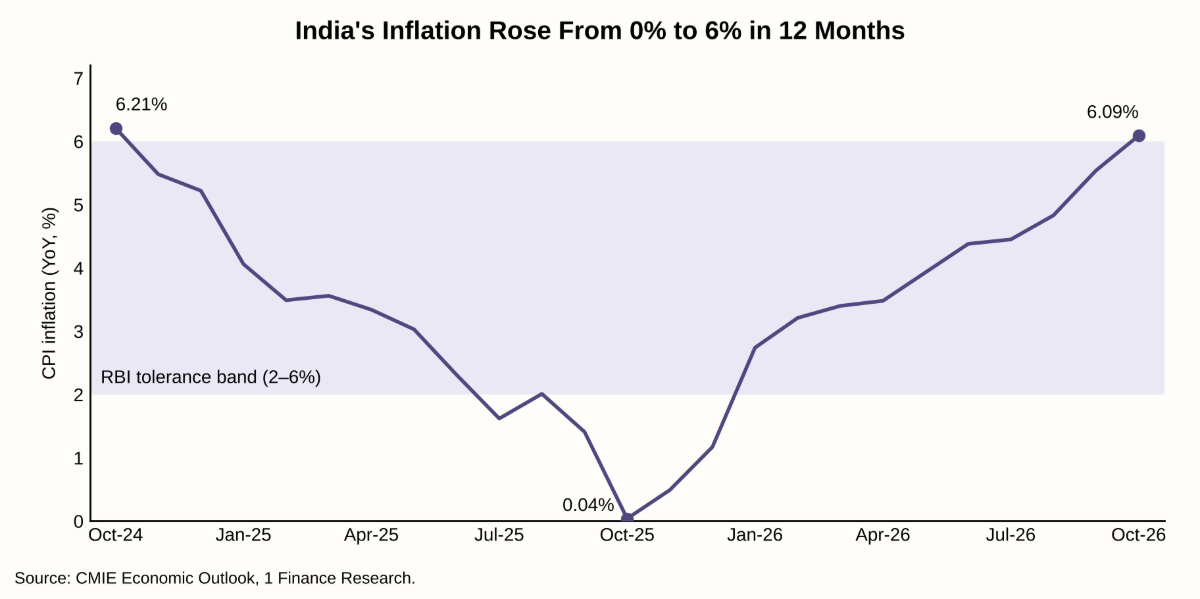
India’s retail inflation crossed the RBI’s tolerance limit for the first time in two years. CPI inflation increased to 6.09% in October, up from 5.54% in September. One year earlier, in October 2025, CPI inflation was close to zero. CPI inflation has risen by six percentage points over twelve months.
The 6% mark is important because the RBI has a mandate to keep inflation near 4%, with an upper limit of 6%. If it breaches that limit, the issue is no longer just a forecasting problem; it turns into a real policy problem. The central bank clearly saw this coming. On October 7, it raised the repo rate by 25 bps to 5.50%, and it changed its stance from "Neutral" to "Calibrated Tightening".
Rural Households Are Paying More Than Urban Ones
The national average hides a gap that has been widening all year. Rural inflation came in at 6.63% in October, against 5.41% in urban India. In January, the two were almost identical, at 2.73% and 2.75%. By October, the rural number was 1.22 percentage points higher.
The reason is how households spend. Food takes up a much larger share of a rural household’s budget than an urban one, so a food price shock pushes up the rural cost of living faster and harder. October’s data confirms this: rural food inflation was 8.7%, against 8.19% in urban India. Rural incomes are already under pressure from a weak kharif season, so higher food bills cut directly into spending on everything else. Companies that depend on rural demand should expect to feel this in the coming quarters.
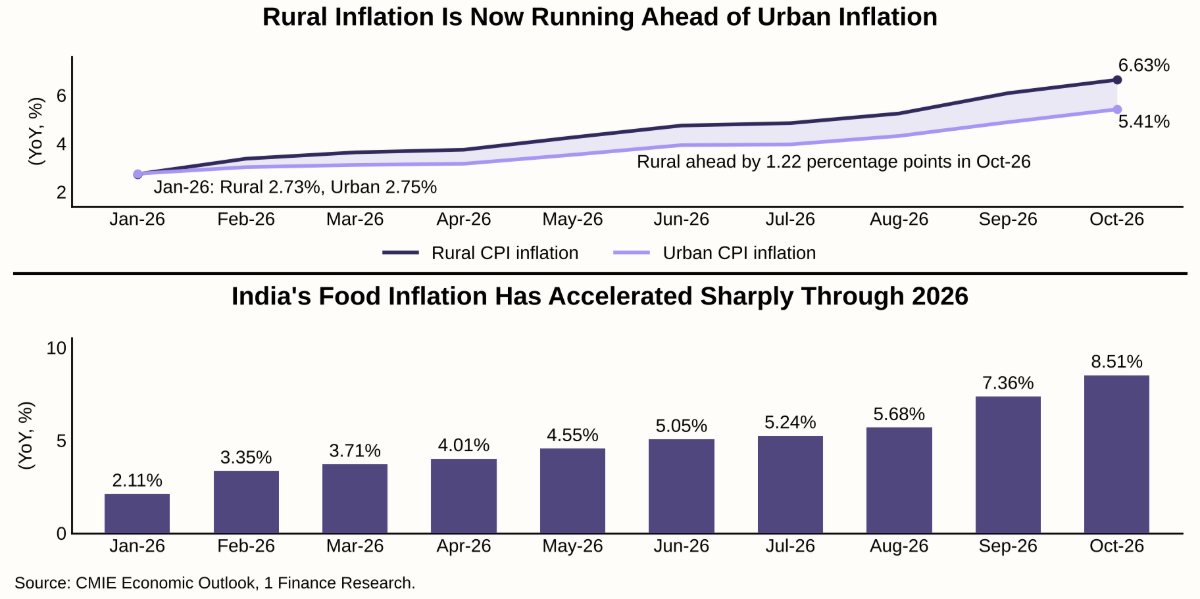
Food is doing most of the damage. Food & Beverages inflation rose to 8.51% in October from 7.36% in September. This was not a one-item spike. Eight of the nine food sub-groups recorded higher inflation than a month earlier.
Inflation Will Peak Above the RBI’s Forecast This Quarter
In its October policy, the RBI raised its FY27 CPI inflation forecast to 5.2% from 5.0%, projecting 6.0% for the December quarter. One month in, October’s 6.09% is already above that.
Our forecast puts November inflation at 6.25%, the peak of this cycle, with the December quarter averaging 6.11%. After that, we expect inflation to ease gradually as the rabi harvest arrives. It should average 5.65% in the March quarter, close to the RBI’s 5.70%, before rising again to 5.78% in the June 2027 quarter, above the RBI’s 5.60%.
| Period | RBI projection | 1 Finance Projection |
|---|---|---|
| Q3 FY27 (Oct to Dec) | 6.0% | 6.11% |
| Q4 FY27 (Jan to Mar) | 5.7% | 5.65% |
| FY27 full year | 5.2% | 5.16% |
| Q1 FY28 (Apr to Jun) | 5.6% | 5.78% |
With inflation at 6.09% and the repo rate at 5.50%, India’s real policy rate is negative, so policy is still loose even after October’s hike. Our forecast keeps inflation above the RBI’s 4% target through FY28, so that gap will not close on its own. As a result, we expect a 25 bp hike on 4 December and another 25 bp in February.
Foreign Money Has Come Back to India as the AI Trade Unwinds
Jensen Huang resigned as Nvidia’s CEO on November 12, effective immediately, following press reports about his personal relationships. Despite Nvidia reporting results that beat forecasts, the stock has fallen about 36% from its peak of $243.37 to $155.46 as of November 18.
The broader AI trade has also lost momentum. The Nasdaq Composite has fallen about 14% from its peak of 31,361 to 27,114 as of November 18. The pullback reflects investor concern that heavy spending on AI infrastructure may take longer to translate into earnings, alongside a less supportive global risk environment.
The US midterms have added to the pressure. The Democrats won both the House and Senate, which raised the risk of tighter regulation of AI and data centres at a time when investors were already uneasy about how much companies are spending on AI infrastructure.
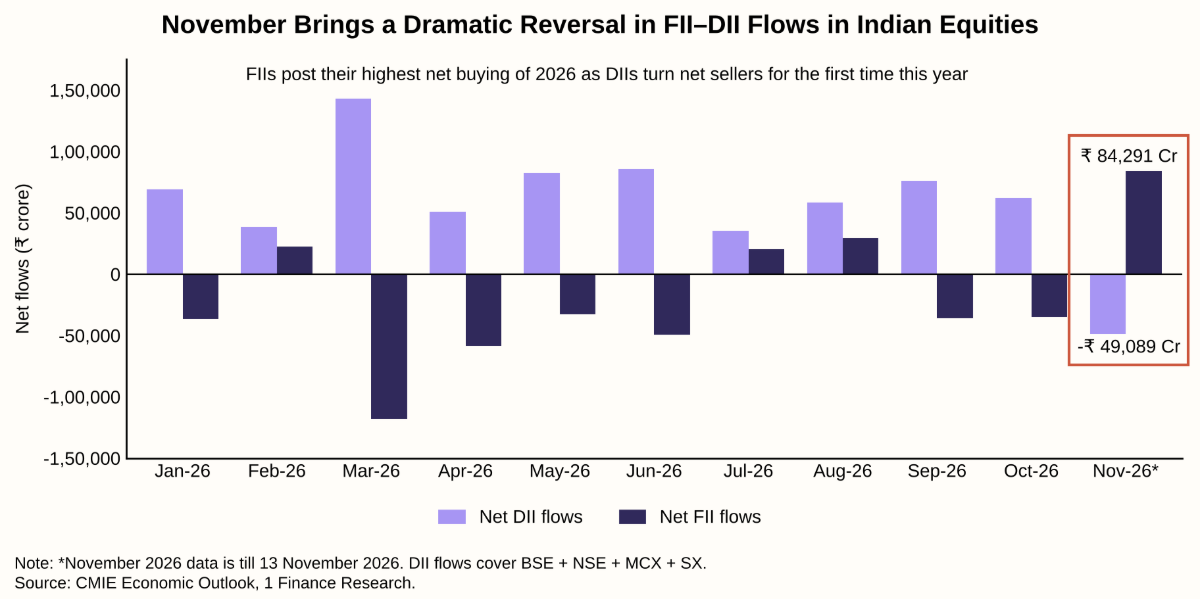
India has very little AI hardware exposure, so a lot of that money has moved here. FIIs sold ₹35,861 crore in September and ₹34,843 crore in October. In November, they bought ₹84,291 crore up to 13 November, more than both months of selling combined.
Domestic institutions have moved the other way. After buying every month from January to October, DIIs turned net sellers in November, selling ₹49,089 crore up to 13 November. We read this as domestic profit-taking alongside foreign buying.
But the broader picture remains more nuanced. Despite November's strong foreign inflows, FIIs remain net sellers of ₹2 lakh crore in 2026. The Nifty's trailing P/E of 20.7 is also below its 10-year median of 23.1, suggesting valuations have moderated. One month of foreign buying is encouraging, but it is too early to call it a reversal of the broader trend.
Indian markets have spent November celebrating foreign inflows. The biggest threat to those inflows is building in the US, where inflation is running well above the Fed’s 2% goal.
US Producer Prices Are Pushing the Fed Toward a December Hike
The Producer Price Index measures the prices US businesses receive for their goods and services. It matters more than its headline suggests. The Fed’s preferred inflation measure is the Personal Consumption Expenditures (PCE) Price Index, and several PCE categories come straight from PPI data: airfares, portfolio management fees and parts of healthcare.
The October release, published on 13 November, confirmed that price pressure is spreading. On an unadjusted basis, the index for final demand increased 6.5% for the 12 months ended in October, the largest 12-month rise since November 2022.
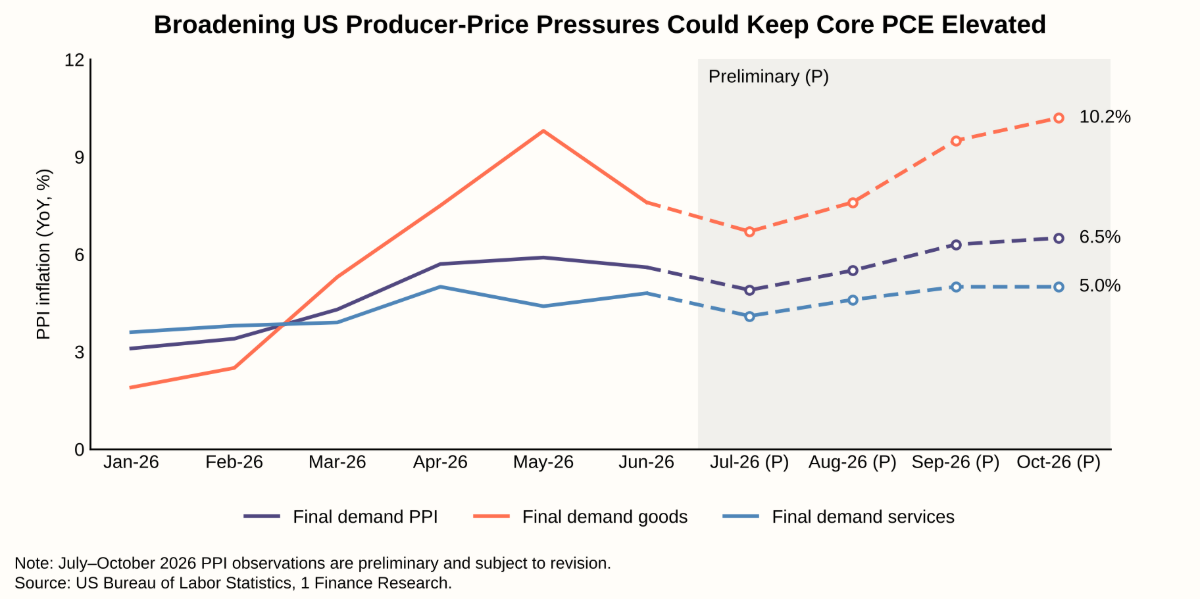
The chart shows how much has changed this year. In January, all three measures were below 4%. Services inflation, which matters more for core PCE, has risen steadily from about 3.6% to 5.0%. Services inflation is tied to wages and freight costs and tends to stay high for longer. With services PPI at 5%, we expect core PCE to stay well above the Fed’s comfort zone into early 2027.
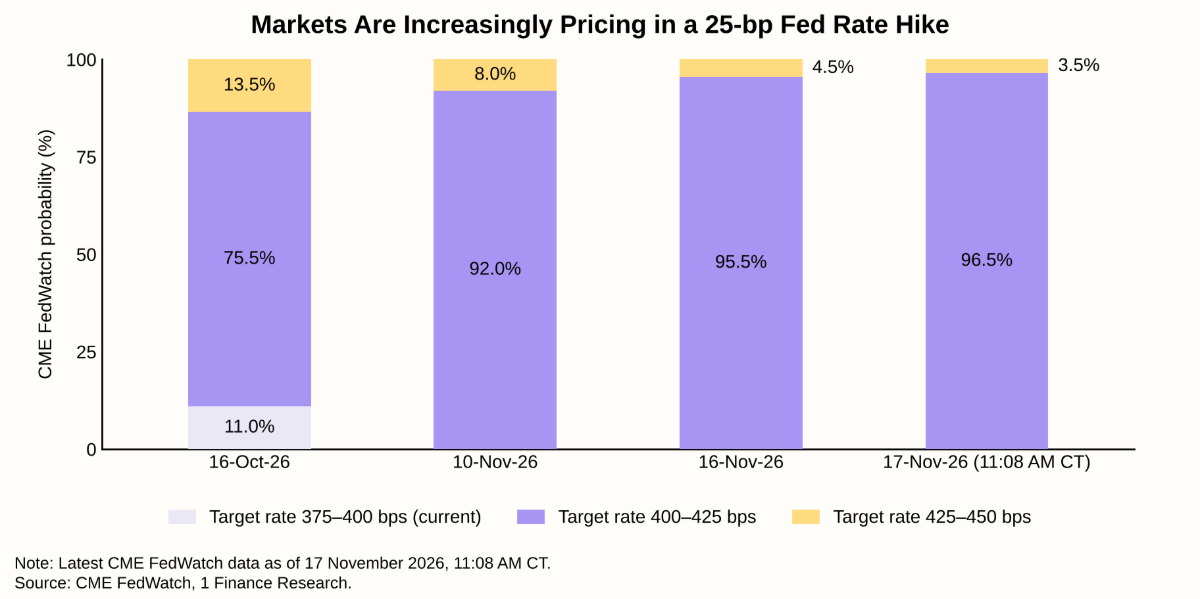
The Fed held rates at 3.75% to 4.00% in October and meets next on 8 and 9 December. The CME FedWatch chart shows how quickly the odds of a December hike have firmed up. On 16 October, markets still gave an 11% chance that the Fed would hold. By 10 November, that chance had fallen to zero. As of 17 November, markets put a 96.5% probability on a 25 bp hike to 4.00% to 4.25%, and 3.5% on a 50 bp move.
Fed Governor Chris Waller said he would consider backing a jumbo rate hike of 50 basis points at the December policy meeting if core inflation continues to come in at 0.3% or higher.
We expect a 25 bp hike in December, which would take the target range to 4.00% to 4.25%. We assign a low probability to a 50 bp hike. Waller’s comments make it possible, but a cautious Fed is unlikely to make a large move after the midterms.
We are less confident that December will be the last hike. Goods PPI is above 10%, and services PPI is rising steadily, so we think core PCE will stay too high for the Fed to stop. Our base case is one more hike in Q1 2027, with a Medium probability of a second. We see no realistic chance of a rate cut before the second half of 2027.
Why This Matters for Indian Investors US rate hikes put the November foreign inflows at risk. With US 10-year yields above 5%, US bonds offer foreign investors a smaller sacrifice for staying at home rather than investing in Indian equities and bonds. A stronger dollar also puts pressure on the rupee, which has only just recovered. For the RBI, a stronger dollar and weaker rupee would add to imported inflation when CPI is already above 6%, which strengthens the case for another rate hike in December. |
Global Financial Conditions Are Tightening
The Fed’s hawkish turn is already showing up across global markets. US yields are higher, the dollar is stronger, and gold has corrected sharply. Together, these signal that global liquidity is getting tighter, even though India’s own growth story remains intact.
The dollar is at a 19-month high. The US Dollar Index (DXY) has risen from 98.32 at the end of December to 103.48 as of 17 November. US yields remain above 5%. The 10-year Treasury yield has risen from 4.15% at the end of December to 5.12%, after peaking at 5.29% in September. Gold has fallen sharply despite the war. Gold prices hit $3,830.74 a troy ounce on Monday, the lowest since October 2, 2025, for a drop of 31.5% since hitting a record high at $5,594.82 an ounce in January, putting it on track for its worst year since 2015.
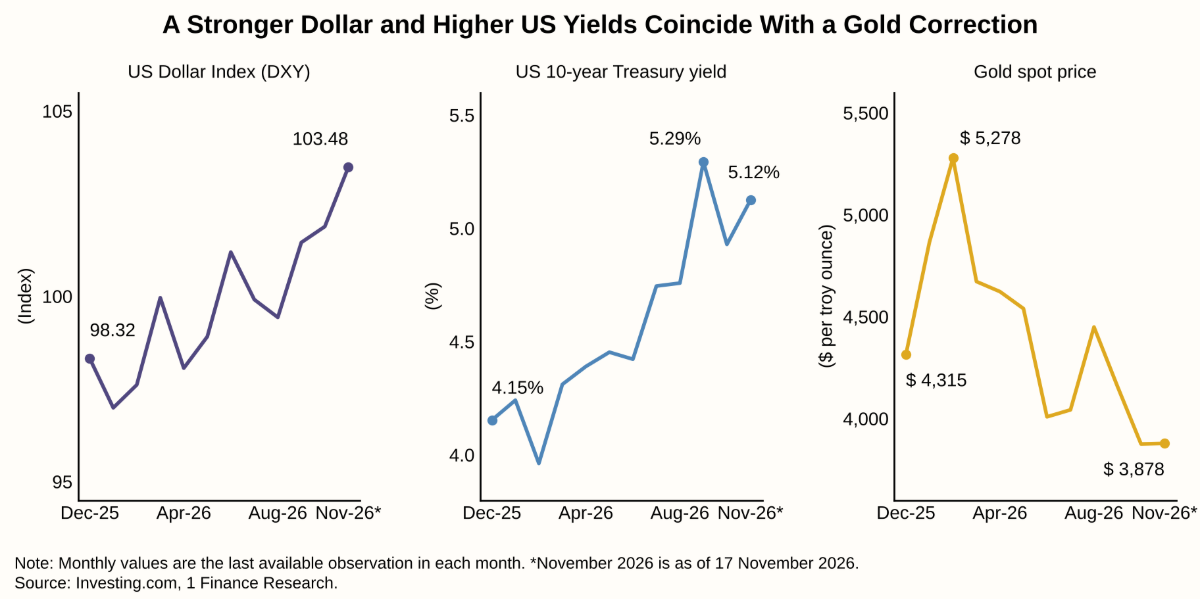
Gold usually rises when geopolitical risk is high. This time, higher yields have outweighed that demand. When US Treasuries pay above 5%, holding gold, which pays no interest, costs investors more, and a stronger dollar makes gold more expensive for buyers outside the US. We read these three moves as one signal: global financial conditions are getting tighter.
These global moves feed directly into India’s import bill, and October’s trade data shows how much they are costing the country.
India’s Trade Deficit Hit a Record in October
India’s merchandise trade deficit widened to ₹3.81 lakh crore in October, up from ₹2.89 lakh crore in September. The increase in imports was primarily driven by higher petroleum purchases, with petroleum imports rising to a record ₹2.18 lakh crore, up 66.7% year-on-year.
This contributed to total merchandise imports reaching a record ₹8.53 lakh crore, up 19.8% from September. Meanwhile, exports also touched a record ₹4.73 lakh crore but were insufficient to offset the surge in imports. Consequently, the trade deficit reached its widest monthly level in rupee terms in data going back to July 2018. This is the cost of the war showing up in India’s import bill.
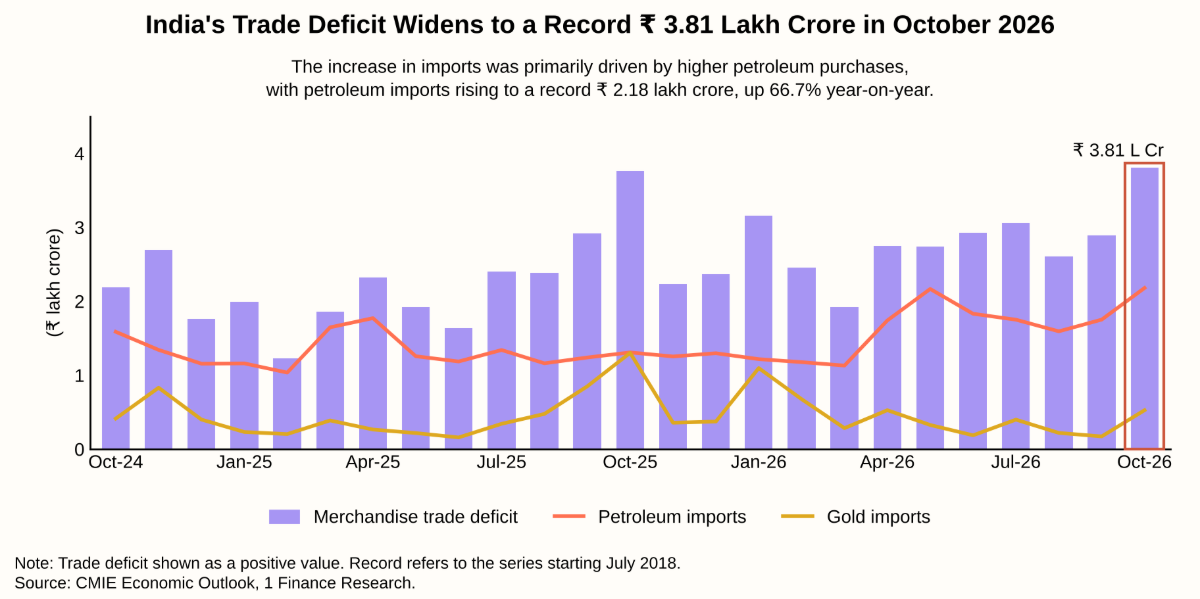
However, the deficit is likely to fall in November on account of lower oil and gold imports. Brent has fallen about 21% since the start of the month, and gold is at a one-year low, so both import bills should shrink.
India’s strong services surplus offsets a large part of the goods deficit. The main risk is oil. If US-Iran talks break down and Brent goes back above $100, the deficit would move higher, just as a strong dollar is already weighing on the rupee.
Conclusion
India has real strengths going into this stretch. With very little AI hardware exposure, it has drawn back foreign money as the AI trade unwinds, and its growth story remains intact. A strong services surplus offsets a large part of the goods deficit, and the record October trade gap should narrow in November as Brent has fallen about 21% and gold imports ease.
The risks are on the other side of the ledger. Inflation has moved past the RBI’s limit, and we expect it to average above 6% this quarter, which raises the likelihood of more rate hikes ahead. The Fed is set to hike on 8 and 9 December, with one more likely in Q1 2027, and a stronger dollar could weigh on the rupee. One strong month of foreign buying does not yet undo a year of foreign selling. For clients, that means staying invested in India’s growth story while phasing in new money and rebalancing old gains.
What Advisors Should Do Now
- Phase in new debt money. A December hike is likely from both the RBI and the Fed, so fresh deposits and short-duration funds should pay more over the next two months. Stagger entries and add duration later.
- Judge returns after inflation. With CPI at 6.09% and expected to stay above 4%, a 6% deposit no longer keeps pace. Clients’ own inflation may be even higher, especially for rural or food-heavy households, so use our Personal Inflation Calculator to check it before reviewing their cash and fixed deposit holdings.
- Prepare borrowers and depositors early. More hikes are likely, so talk through higher EMIs on repo-linked loans now. For FDs, ladder across short tenures rather than locking in long ones, so clients can reinvest as rates rise.
- Add Indian equities in stages. November’s inflows are encouraging, but foreign investors remain net sellers for the year. The Nifty's trailing P/E of 20.7 is below its 10-year median of 23.1, suggesting valuations have moderated. Invest new money gradually over the next six months, focusing more on large-caps.
- Use SIPs for global funds. Maintain global diversification and avoid excessive concentration in any single market. The Nasdaq Composite is down about 14% from its peak. Rebalance overweight positions and use SIPs or STPs to maintain exposure gradually rather than making lump-sum investments.
- Watch domestic flows. DIIs turned net sellers in November after buying every month from January to October. If foreign buying fades while domestic institutions keep selling, the market loses its support.