The November 3, 2026 US midterm elections are set to change the balance of power in Congress, with unofficial results indicating that Democrats have secured control of both the House and SenateAlthough the overall outcome is becoming clear, votes in some constituencies are still being counted, and official state certification is pending. President Donald Trump, however, remains in office until January 20, 2029.
The election therefore changes the political constraints on the President, not the presidency itself. A Democratic-controlled Congress could make it harder for Trump to pass new legislation, approve spending and secure appointments, while expanding congressional oversight. But it would not automatically reverse existing tariffs, executive actions or foreign-policy decisions.
What the Midterms Election Decide
The US has two main parties. Republicans, President Trump's party, favour lower taxes, lighter regulation and tariffs to protect US industry. Democrats favour a bigger government role in healthcare and household costs, funded by higher taxes on top earners and companies.
Voters elected all 435 House members, who serve two-year terms, and about one-third of the Senate, whose members serve staggered six-year terms. Before the vote, the House had 218 Republicans, 214 Democrats, one independent and two vacancies. The Senate had 53 Republicans, 45 Democrats and two independents counted with the Democrats. The new Congress sits from January 3, 2027.
Democrats vs Republicans on How the Economy Should Work
Every four years, each party publishes a platform, an official document listing what it promises to do in government. The Republican and Democratic 2024 platforms are the latest. Their 2026 positions appear in the policy-battles table below.
| How Each Party Says the US Economy Should Work | ||
|---|---|---|
| Economic question | Republican view | Democratic view |
| Who should pay more tax? | No one. Make the 2017 tax cuts permanent and end taxes on tips | The top. No rise for anyone under $400,000, a 25% minimum tax on billionaires and a 28% corporate rate |
| How should trade work? | Baseline tariffs on foreign goods and a Reciprocal Trade Act | Oppose extreme import tariffs that raise living costs |
| Where should energy come from? | More domestic oil and gas, including nuclear | Record investment in renewable energy |
| What role for government in healthcare? | Protect Medicare | Healthcare is a right, with insulin capped at $35 and Medicare negotiating drug prices |
| How should new technology be regulated? | Repeal the Biden-era AI order it says hinders innovation | Treats AI as a growth industry, with no detailed rules |
Who Controls Lawmaking
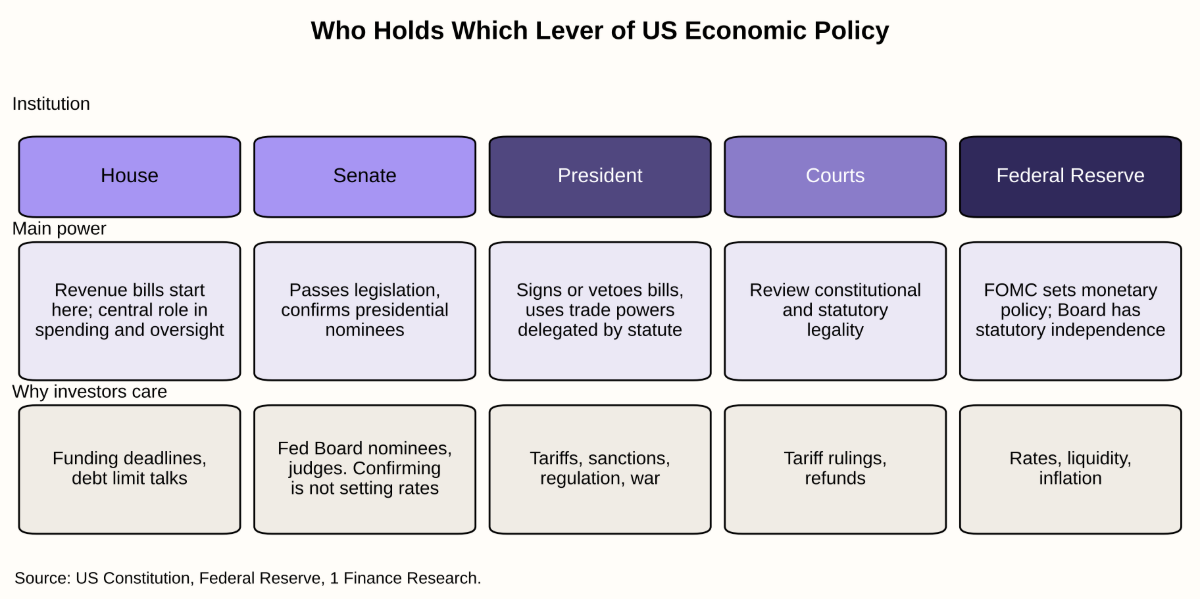
Under Article I, Section 7, a bill must pass both chambers and go to the President. The House passes bills by simple majority.
Senators can keep debating a bill to delay its vote, known as a filibuster. A cloture vote is a vote to stop the debate and move to a final vote. It needs 60 of 100 senators for most bills. Only then can it pass by simple majority, so a slim Senate majority cannot pass most bills on its own. A presidential veto can be overridden only by two-thirds of members voting in each chamber.
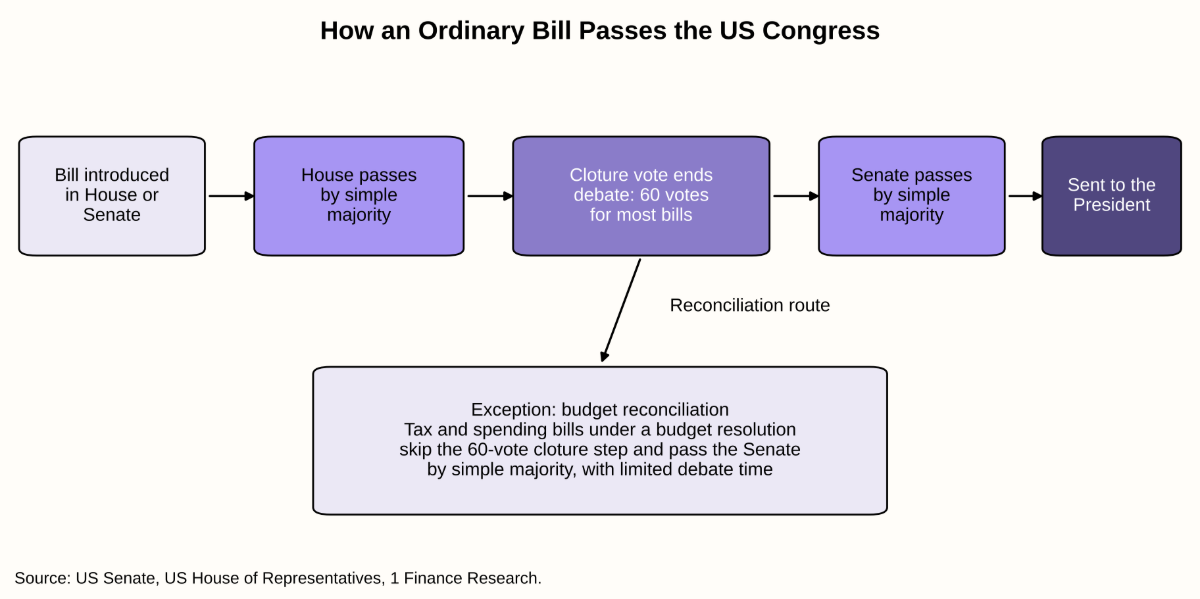
Tax and spending bills have a shortcut, called budget reconciliation. A bill that only changes taxes or spending can then pass the Senate with 51 votes. So a slim majority can pass big money bills alone.
Recommended for you
Readers also explored
World GDP Breakdown 2025: Who Powers the Global Economy?
 8 min read

Nifty 50 Companies List 2025 : Top 50 Stocks in India
7 min read
Republicans used this shortcut to pass one large law, the One Big Beautiful Bill Act, signed on July 4, 2025. Per Congress's bill summary, it made many 2017 tax cuts permanent, gave tax breaks on tips and overtime, tightened work rules for food aid and added money for defence and the border. It also raised the government's borrowing limit by $5 trillion.
The shortcut only works in the Senate. The bill must still pass the House. With Democrats running the House, Republicans cannot pass another law like this on their own. That means less chance of new tax cuts adding to US borrowing.
Gridlock and What Changes or Stays
Gridlock means Washington gets stuck. Gridlock is a word borrowed from traffic. It means a jam where no car can move. In politics, it describes a government where the two sides keep blocking each other, so very little new gets done.
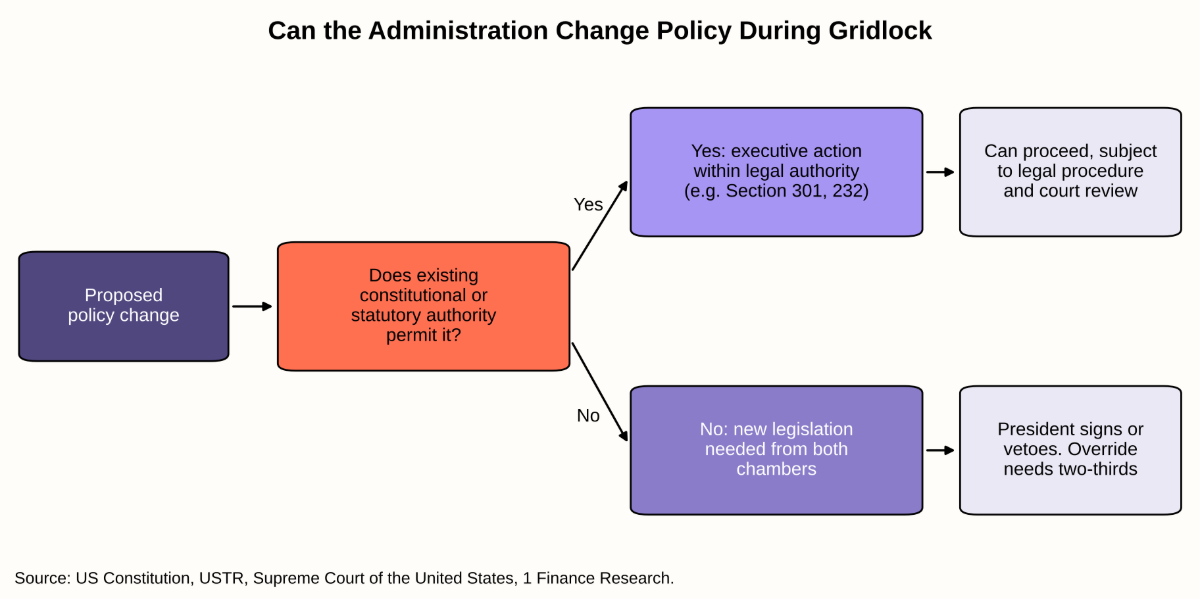
A new US law needs approval from the House, the Senate and the President. When rival parties hold them, each can block the others. A Democratic bill to cut tariffs, for example, would face Trump's veto. A Republican push for another tax cut would stall in a Democratic House. No new law passes, while existing tariffs and tax laws stay in force. For investors, gridlock means policy continuity, not reversal. It shows up in three ways.
- New laws stall. Neither party can pass major bills on its own.
- Money fights get harder. Government funding is approved only until December 11, 2026. The debt limit, the cap on government borrowing, is $41.1 trillion, and the Congressional Research Service says borrowing is projected to near it in FY2027.
- Existing policies carry on. Tariffs and other actions under current law continue unless changed or struck down by courts.
If funding runs out, parts of the government shut down, though essential work continues. A debt-limit stand-off is worse, because the Treasury could struggle to pay its bills.
The 2026 Policy Battles and Who Wins Them
| The Live Policy Fights of 2026 | ||||
|---|---|---|---|---|
| Issue | In force today | Democratic push | Our assessment | Investment angle |
| Tariffs | Section 301 duties of 10% or 12.5% on covered products of 60 economies, plus Section 232 metal duties | Stop the Trump tariffs | Duties likely continue | Exporters, supply chains |
| AI | Executive Order 14365 directs challenges to state AI laws | Make data centres pay for their electricity | Federal preemption law unlikely | AI, power utilities |
| Healthcare | No extension of enhanced ACA tax credits | Extend credits, reverse 2025 Medicaid cuts | Likely vetoed | Insurers, hospitals |
| Iran conflict | Operations continue | Congress to approve the use of force | Funding becomes the lever | Oil, defence |
Note: The last two columns are our assessment.
Tariffs rest on powers Congress delegated. On February 20, 2026 the Supreme Court held that the International Emergency Economic Powers Act (IEEPA) does not authorise the President to impose tariffs. The administration then used other trade laws, Section 301, Section 232 and, against Canada, Section 338.
Artificial intelligence (AI) risk sits with the states. The White House AI framework asks Congress to override state AI laws, but Executive Order 14365 carves data centre infrastructure out of that call. Both the White House and Democratic Leader Hakeem Jeffries say households should not carry data centre power costs, so state permits and power prices pose the bigger risk.
War runs on executive power, money runs through Congress. Congress agreed House Concurrent Resolution 86 on June 23, 2026, directing the President to remove US forces from hostilities with Iran. It is not an enacted law, and operations continued. The Congressional Budget Office estimates Defense Department costs of about $38 billion as of August 1, 2026, not the war's total economic cost.
How US Politics Reaches Global Markets
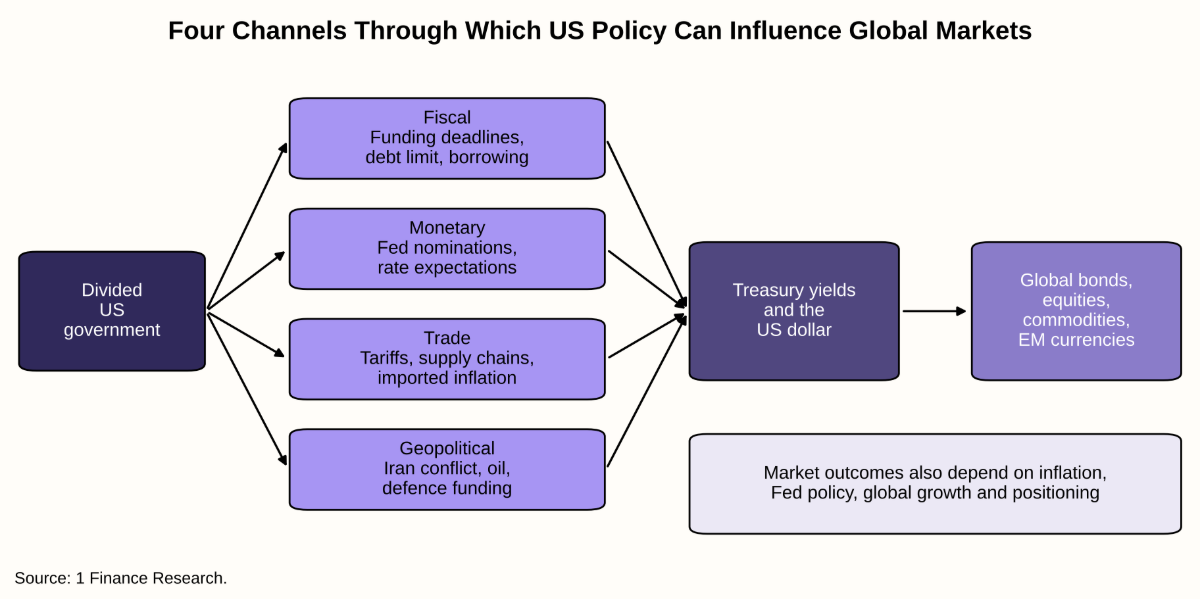
Fiscal. Gridlock blocks new deficit-raising laws but does not cut the existing deficit. The US Treasury estimates borrowing of $618 billion for October to December 2026 and $800 billion for January to March 2027.
Monetary. The Federal Reserve held its target range at 3.75% to 4.00% on October 28, 2026, while two members preferred a 25 basis point increase. US CPI inflation was 3.7% year on year in September.
Trade. Tariffs raise costs for US importers and consumers, depending on how much is passed on, and shift global supply chains.
Geopolitical. Oil follows the Iran conflict and shipping through the Strait of Hormuz more than congressional votes.
What Gridlock Could Mean for US Bond Yields
A divided Congress makes big tax and spending changes harder to pass. That limits new fiscal laws, but it does not by itself cut government borrowing or the deficit. Bond markets will watch whether the result changes expectations for borrowing, inflation and growth.
The 2026 yield curve gives useful context. Between January 2 and November 3, the 2-year yield rose from 3.47% to 4.61% and the 10-year from 4.19% to 4.95%, per US Treasury data. The gap between them narrowed from 72 to 34 basis points.
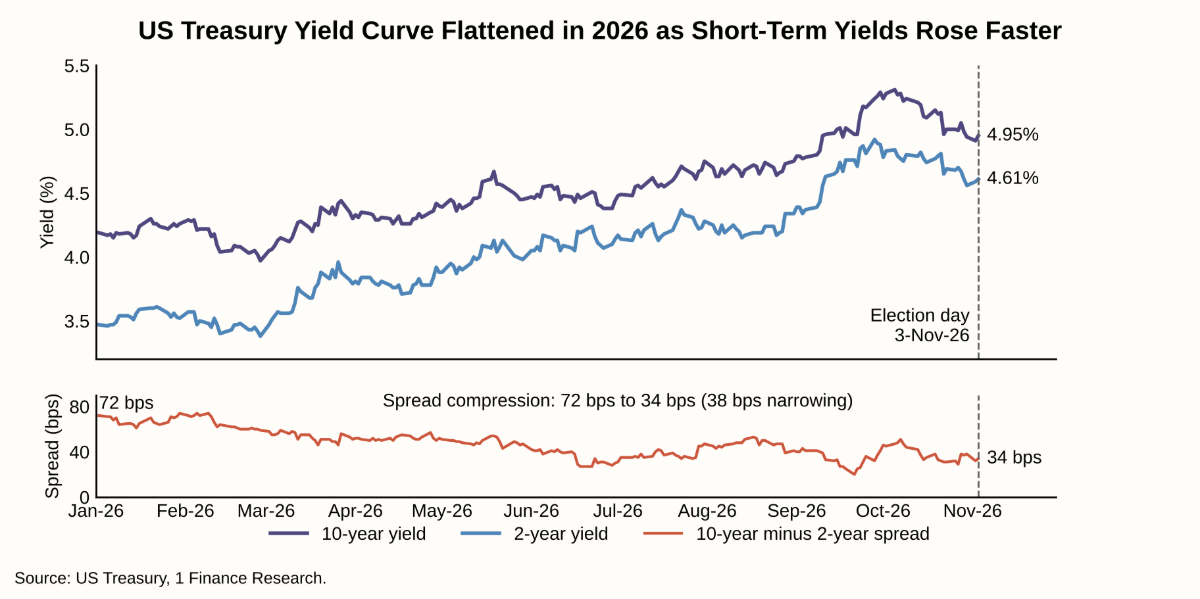
This movement reflects many forces, including Fed expectations, inflation, economic data and Treasury supply. It shows why investors should separate short-term rate expectations from longer-term fiscal and inflation risks. For Indian investors, US yields matter because they influence the dollar, foreign portfolio flows, the rupee and Indian bond yields.
Which Global Asset Classes Feel It Most
| How Global Asset Classes Could Move | ||
|---|---|---|
| Asset class | Sensitivity | What drives the move |
| US Treasuries | Very high | Gridlock caps new borrowing, but funding fights can lift yields |
| German, UK and Japanese government bonds (Bunds, gilts, JGBs) | High | US yields can influence global bond pricing |
| US dollar | High | Direction depends on relative interest rates and safe-haven demand |
| Euro, yen, pound | Medium to high | Mirror the dollar. The yen often gains in risk-off moves |
| EM currencies, including the rupee | High | Depend on the dollar, oil prices and capital flows |
| US tech and AI stocks | High | Regulation and power costs, separate from AI investment returns |
| Europe and Japan equities | Medium | Follow US tech sentiment and their currencies |
| EM equities, including India | Medium to high | Helped by a weaker dollar, hurt by rising US yields |
| Gold | High | Real yields, the dollar and geopolitical risk |
| Crude oil | Conditional | Supply shocks and the Iran conflict, not congressional action |
| Bitcoin | High, unpredictable | Speculative. Driven by liquidity, risk appetite and crypto rules, not a political hedge |
Note: These rankings are qualitative research assessments, not statistical correlations. Sensitivity is not direction.
What It Means for India
India is exposed in two ways: directly through US tariffs, and indirectly through US yields, the dollar and oil, which usually move faster.
Direct: tariffs on Indian goods. India sold $92.28 billion of goods to the US in 2025 and bought $50.27 billion, a $42.01 billion surplus, per the Department of Commerce. Electrical machinery and equipment made up $25.77 billion, about 28% of that.
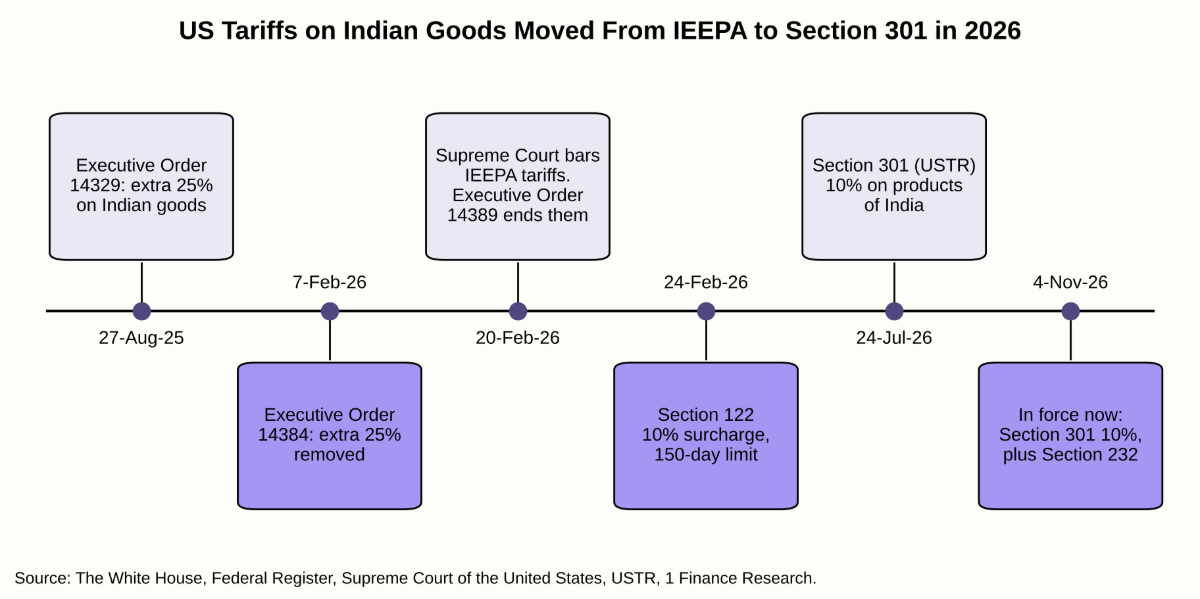
The timeline shows the legal basis for these tariffs changing three times in 2026, each time by the White House or the courts, not Congress. Today's 10% Section 301 duty on covered Indian products was announced by the Office of the US Trade Representative (USTR) on July 23 and took effect on July 24, with exemptions. The midterms do not change it directly.
Indirect: money and oil. The reference rate set by Financial Benchmarks India Limited (FBIL), shown on the RBI website, was ₹94.86 per dollar at 1 pm on November 3, 2026, weaker than the January range of ₹89.89 to ₹91.96 in the RBI Handbook. The RBI's Monetary Policy Committee raised the repo rate to 5.50% on October 7.
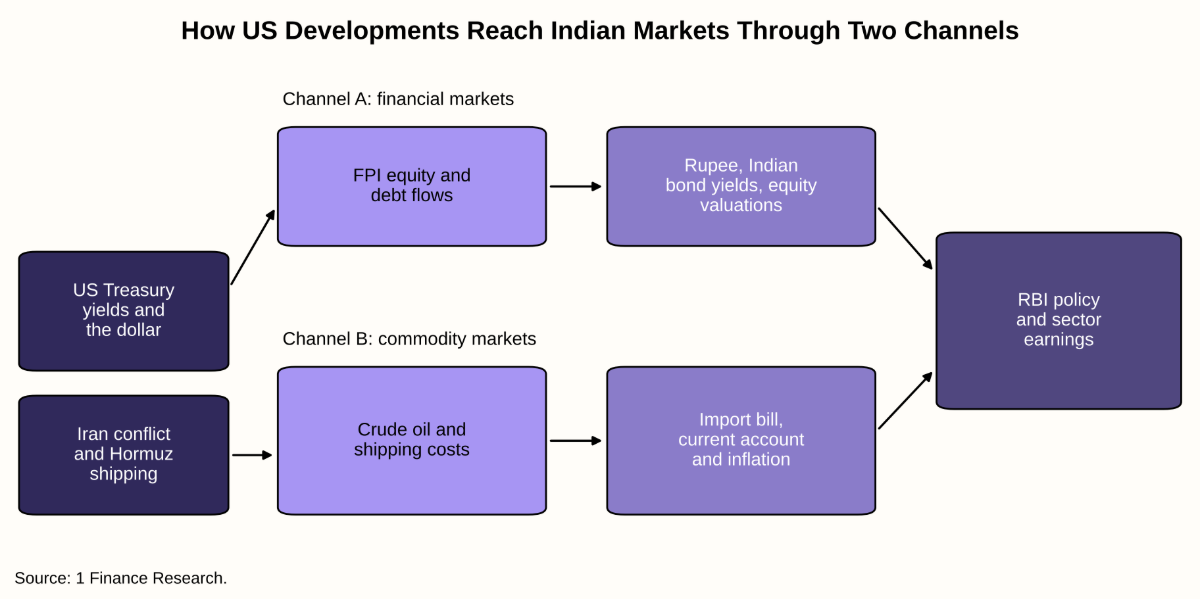
The chart shows two routes. Higher US yields and a stronger dollar can pull foreign money out of Indian stocks and bonds, weakening the rupee. Separately, the Iran conflict moves oil and shipping costs, which feed India's import bill and inflation. Both end at RBI policy and company earnings
💡 Why the Rupee Matters for US Holdings (Illustrative Example) A client sent $10,000 to a US fund in January 2026 under the Liberalised Remittance Scheme (which allows up to $250,000 abroad a year), when the rupee was at ₹89.89. That cost ₹8,98,900. At ₹94.8606 on November 3, the same $10,000 is worth ₹9,48,606, a gain of ₹49,706 (5.5%) even if the fund did not move. If US yields fall and the dollar weakens, that gain can reverse. Judge US funds on rupee returns, not dollar returns. |
What Investors and Advisors Should Watch and Do
- Use US yields as the early warning. A return towards October's 5.31% high would likely weaken the rupee and pull foreign money from India. A fall would ease both.
- Keep bond duration moderate until December. Long bonds gain most if yields fall, but lose most if a December 11 funding fight or debt-limit stand-off lifts yields.
- Judge US funds in rupees and add in stages. Part of this year's gain came from the rupee's fall, which can reverse. Check how much rests on a few US AI stocks.
- Do not trade the election result. The 10% tariff on Indian goods changes only through the White House or the courts, so watch USTR exemption notices instead.
- Keep gold as a hedge and bitcoin small. Size bitcoin at a level the client can afford to lose..
Key dates are the Fed meeting on December 8 to 9, the funding deadline on December 11, and the new Congress on January 3, 2027.
Conclusion
Elections feel like turning points, but this one decides who can say no. If early counts hold, Washington will pass few new laws, and the tests become the December 11 funding deadline and FY2027 debt limit.
For India, the lesson is in the data. The rupee slid from about ₹90 to ₹94.86 this year before a single vote was counted. US yields and the dollar, not Congress, set the pace. Build portfolios that work whether yields rise or fall.