When we think of exports, goods and services usually come to mind. But one of India's biggest exports doesn't leave the country in a shipping container or travel through the internet; it boards a flight.
Every year, millions of Indians work overseas, from construction sites in the Gulf and hospitals in the UK to technology firms in the US. In return, they send home nearly ₹12.76 lakh crore as of FY26 in remittances, making India the world's largest recipient of these inflows.
These remittances have become far more than household transfers. They support consumption, strengthen the current account, add to foreign exchange inflows, and contribute nearly 3% of India's GDP. In many states, they have become an important pillar of the local economy.
But there is a bigger question that often goes unasked.
Is India converting this global income into long-term economic growth, or are remittances primarily funding today's consumption instead of tomorrow's investment?
In this blog, we look beyond the headline numbers to understand India's labour mobility story, where Indian workers are going, what sectors they are powering, how remittances shape the economy, and whether this model can remain a sustainable growth engine in the years ahead.
The Growth of Remittances in India
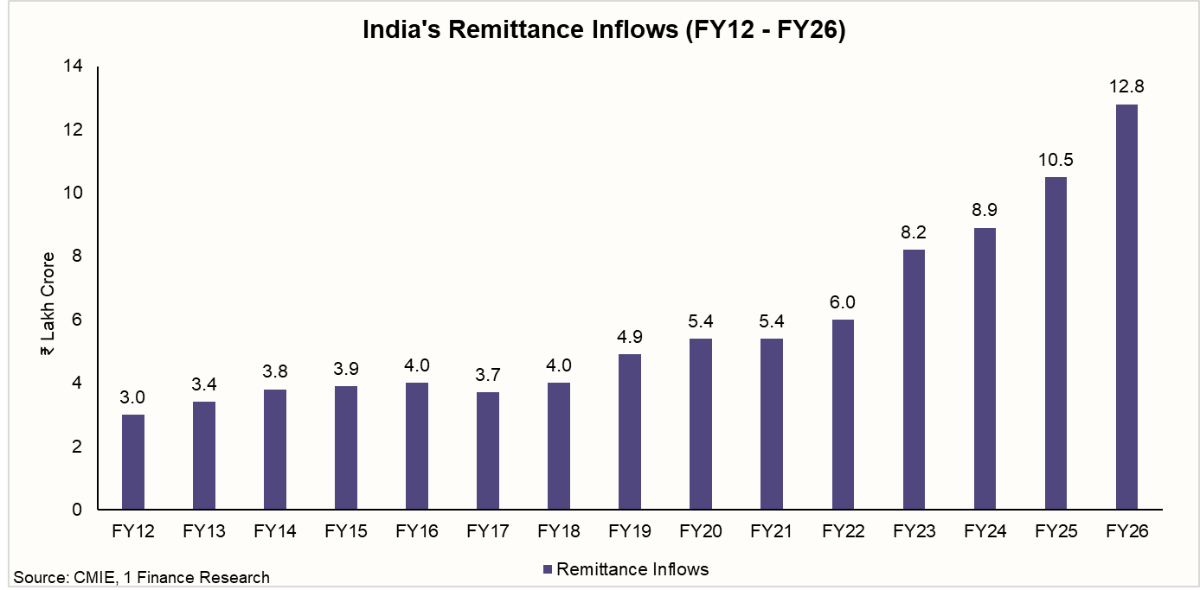
India's overseas workforce has become one of the country's most valuable economic assets. As more Indians have found opportunities abroad and their earning potential has improved, the money flowing back home has grown steadily over the years. Personal transfer inflows have increased from ₹2.95 lakh crore in FY12 to ₹12.76 lakh crore in FY26, highlighting the growing economic significance of labour mobility. Today, these inflows support millions of households while also providing a stable source of foreign exchange that strengthens India's external sector.
Why the World Needs Indian Workers
The sharp rise in remittances is not a coincidence. It reflects a much larger structural shift taking place across the global economy. While many developed nations are grappling with ageing populations and shrinking workforces, India remains one of the few major economies with a large and growing working-age population. This demographic contrast has made Indian workers an increasingly important source of talent across industries and geographies.
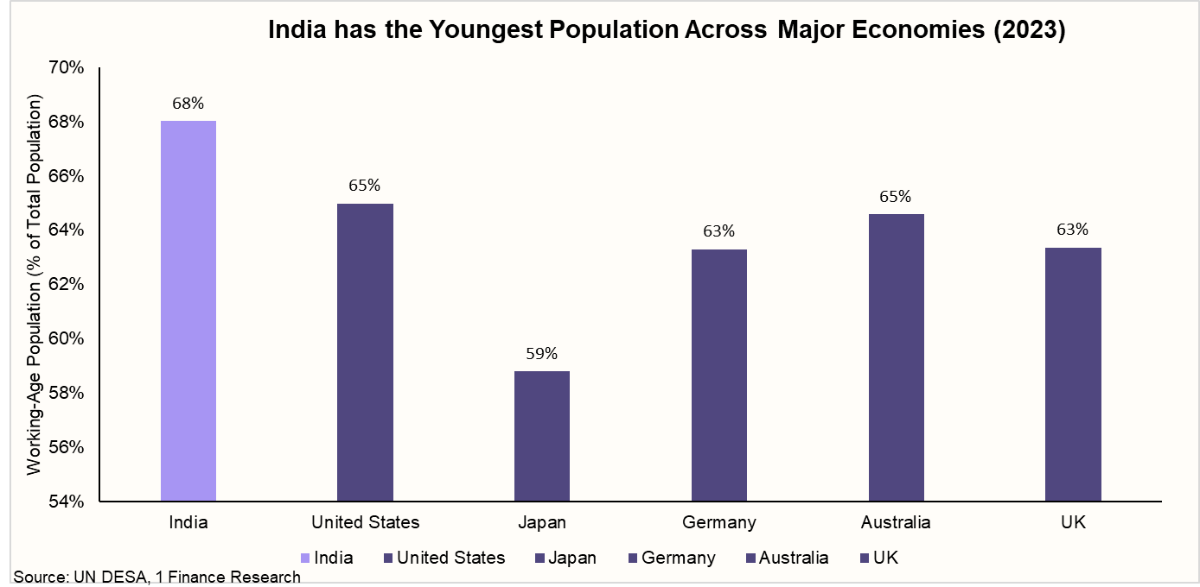
So, why is India exporting workers? India has a relatively larger working-age population than many major destination economies; 68% of its population is aged 15–64, compared with 59% in Japan and around 63% in Germany and the UK. But demographics are only part of the story. India's large labour pool exists alongside limited high-quality employment opportunities at home, while ageing economies abroad face shortages across healthcare, technology, engineering, construction and other sectors. This gap between labour supply at home and labour demand abroad is what continues to push India's workforce overseas.
Where Are Indian Workers Going?
India’s overseas workforce is not concentrated in one part of the world. Millions work across the Gulf, while large Indian workforces have also emerged in the US, UK, Canada and Australia. But these migration corridors are very different; the Gulf has traditionally absorbed more blue-collar and skilled-trade workers, while advanced economies attract a greater share of professionals and highly skilled talent.
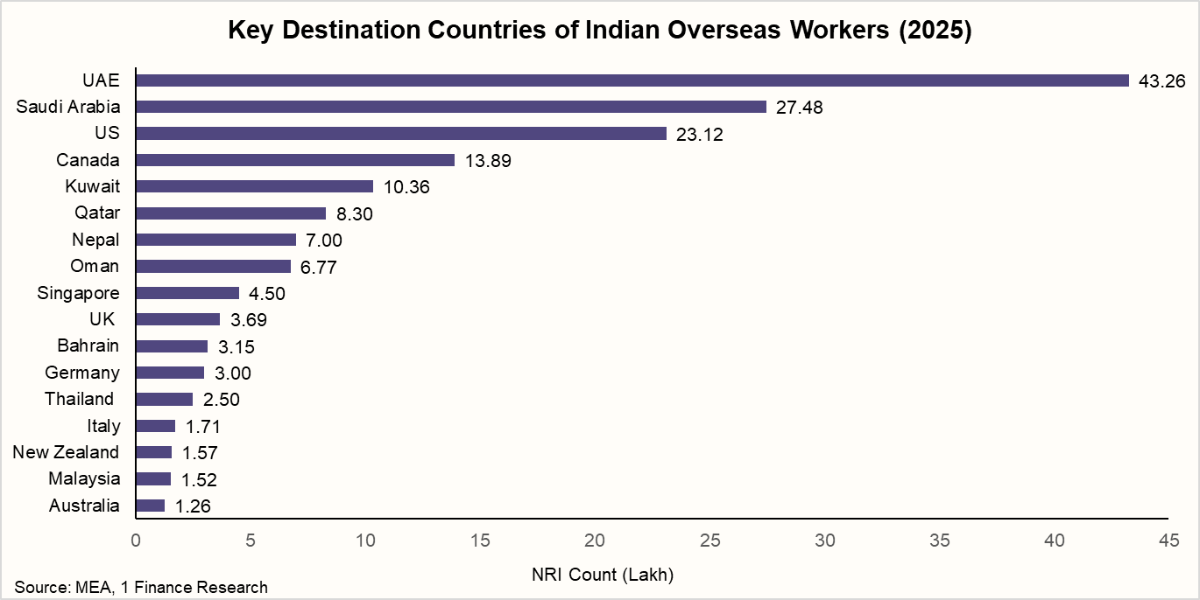
The pattern is clearly concentrated but diverse. The UAE and Saudi Arabia dominate the Gulf corridor, while the US and Canada stand out among advanced economies. Beyond these large hubs, Indian communities are also spread across the UK, Kuwait, Qatar, Oman, Singapore, Australia, Bahrain, Germany, Italy, Malaysia, Nepal, New Zealand and Thailand. But the reasons Indians move to each of these markets differ, from construction and energy in the Gulf to technology, healthcare, and other skilled professions in advanced economies.
| What Draws Indian Workers to Different Countries? | |
|---|---|
| Country | Major sectors attracting Indian workers |
| UAE | Construction, hospitality, retail, healthcare, finance, IT, engineering |
| United States | IT & technology, engineering, healthcare, finance, research |
| Saudi Arabia | Construction, oil & gas, engineering, healthcare, hospitality |
| Canada | IT & technology, healthcare, engineering, skilled trades, finance |
| United Kingdom | Healthcare, IT, finance, engineering, professional services |
| Kuwait | Construction, oil & gas, healthcare, engineering, domestic services |
| Qatar | Construction, energy, engineering, hospitality, aviation |
| Oman | Construction, oil & gas, engineering, healthcare, retail |
| Singapore | IT & technology, finance, engineering, professional services |
| Australia | Healthcare, IT, engineering, education, skilled trades |
| Bahrain | Finance, construction, hospitality, healthcare, retail |
| Germany | IT, engineering, healthcare, research, skilled technical occupations |
| Italy | Agriculture, manufacturing, hospitality, domestic & care services |
| Malaysia | IT, manufacturing, construction, services |
| New Zealand | Healthcare, IT, engineering, agriculture, skilled trades |
What stands out is that India’s labour mobility is not tied to a single type of economy or job market. The Gulf continues to offer opportunities across construction, energy and services, while advanced economies increasingly draw Indian talent into technology, healthcare, engineering and other professional roles. This diversification gives India multiple labour-export corridors rather than dependence on any one destination or sector.
India’s Labour Mobility Strategy
India is increasingly treating labour mobility as an economic strategy rather than just a consequence of migration. Through bilateral labour agreements and mobility partnerships, the government is trying to connect India’s workforce with countries facing specific skill shortages, while creating safer and more structured pathways for Indians to work abroad.
| India's Expanding Labour Mobility Network | ||||
|---|---|---|---|---|
| Country/Bloc | Arrangement | Signed | Key workers targeted | What it does |
| European Union | Mobility framework | 2026 | Students, researchers, young professionals, skilled workers | Creates broader pathways for mobility between India and the EU |
| Austria | Migration & Mobility Partnership | 2026 | Skilled professionals, students, researchers | Facilitates legal work, study and research mobility |
| Italy | Migration & Mobility Partnership | 2023 | Seasonal & non-seasonal workers, healthcare professionals | Creates worker quotas and structured recruitment pathways |
| Germany | Migration & Mobility Partnership | 2022 | Skilled workers, students, researchers | Facilitates work, study and research mobility |
| France | Migration & Mobility Partnership | 2018 | Professionals, students, researchers | Supports professional and academic mobility |
| UAE | Mobility arrangements + CEPA | 2022 onward | Skilled & semi-skilled workers; professional services | Supports worker mobility and temporary movement of professionals |
| Oman | CEPA, Mode 4 provisions | 2025 | Professionals and service-sector workers | Facilitates temporary movement of service providers |
| Australia | ECTA, mobility provisions | 2022 | Professionals, graduates, IT and other services | Supports professional mobility and qualification recognition |
| South Korea | Migration & Mobility Partnership | 2025–26 | Skilled professionals, students | Expands structured legal mobility |
| Brazil | Migration & Mobility Partnership | 2025–26 | Skilled workers, students | Extends India's mobility network into South America |
The shift is important. India is moving from simply supplying workers to countries that need them towards actively negotiating how that mobility takes place. Easier visa pathways, qualification recognition, worker quotas and social-security protection can make overseas employment more organised, and potentially move Indian labour towards higher-skilled, higher-paying opportunities.
India’s growing global workforce is not just filling labour gaps abroad, it is also creating a sizeable economic flow back home. The real value of this labour mobility becomes clearer when we follow the money back to India. Remittances are more than household transfers; at their current scale, they have become an important part of India’s external economy.
How Remittances Support India’s Economy
The importance of remittances becomes clearer when viewed through India's external accounts. India typically runs a sizeable merchandise trade deficit, as its goods imports exceed exports. But that gap does not translate directly into an equally large current account deficit. Services exports and remittance inflows help absorb a substantial part of it. Unlike FDI or FPI, remittances also do not depend on investor sentiment or create an ownership claim on Indian assets, making them a relatively stable external buffer.
| 💡In FY26, India received around ₹12.8 lakh crore in personal transfers, equivalent to roughly 43% of its merchandise trade deficit. In other words, the money Indians send home helps offset a sizeable part of the foreign exchange gap created by India importing more goods than it exports. |
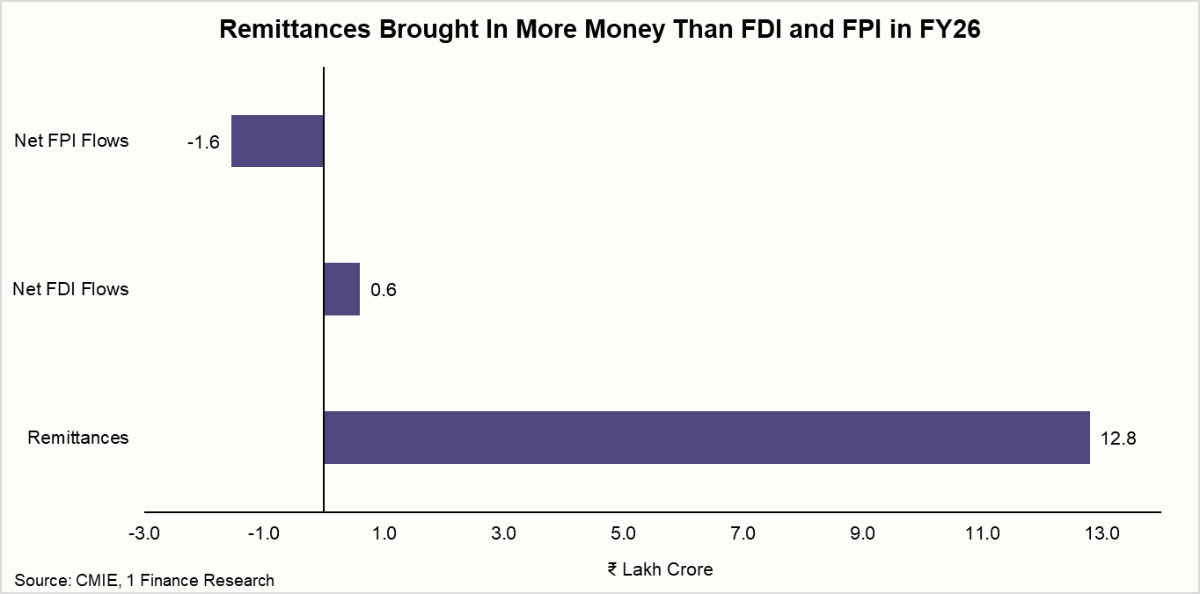
The gap is hard to miss. In FY26, India received ₹12.8 lakh Crore in remittances, while net FDI was just ₹0.6 lakh Crore and net FPI was actually negative at – ₹1.6 lakh Crore. On one hand, this highlights just how powerful India’s remittance engine has become. On the other, such a wide gap is not entirely positive; it also shows how limited foreign investment flows have been relative to the income Indians are earning and sending home from abroad. Remittances are providing a strong external cushion, but ideally, they should complement, not overshadow, productive investment coming into the economy.
How Much Do Remittances Support India’s Current Account?
Remittances have consistently provided a sizeable positive flow to India’s current account, helping counterbalance the country’s merchandise trade deficit. In FY26 alone, personal transfers brought in around ₹12.8 lakh Crore. Their importance becomes even clearer when compared with India’s current account balance: without this recurring stream of income from Indians abroad, India’s external deficit would be considerably wider and its dependence on foreign capital to finance that gap much greater.
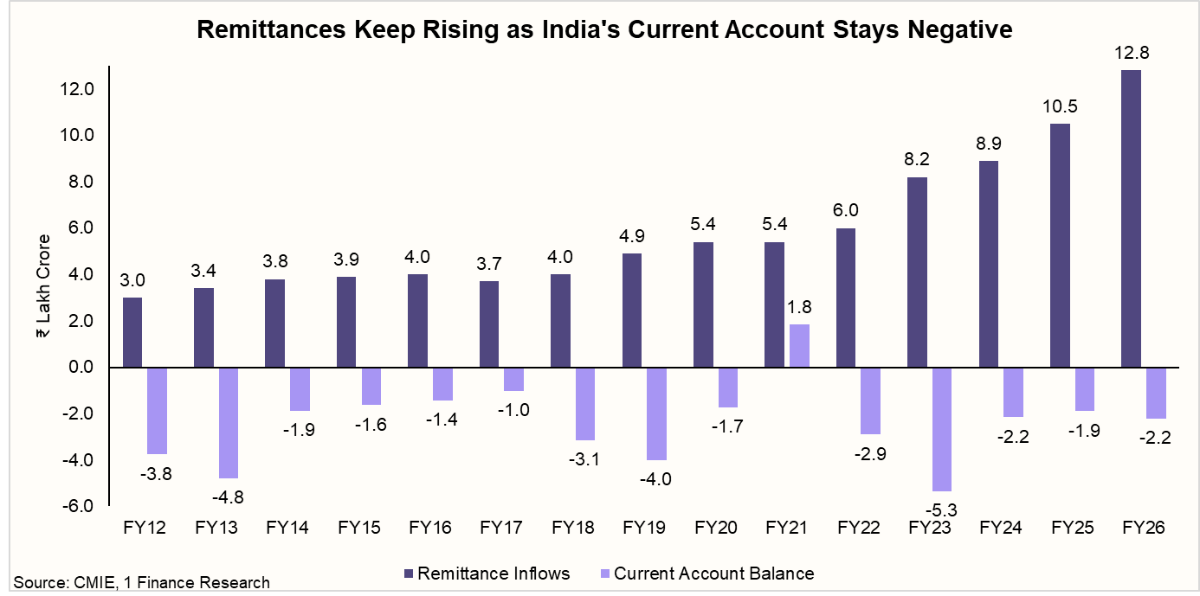
The divergence is striking. While India’s current account has remained in deficit in most years, remittance inflows have more than quadrupled, from around ₹3 lakh crore in FY12 to ₹12.8 lakh crore in FY26. These inflows provide a sizeable cushion to the current account, offsetting part of the deficit created elsewhere in India’s external transactions. As remittances grow, overseas Indian workers are therefore becoming increasingly important not just to household incomes, but also to India’s external stability.
Are India’s Remittances Fueling Consumption or Investment?
Receiving ₹12.8 lakh Crore is one thing. What happens to that money after it reaches India is another. A large part of remittance income goes towards supporting household consumption and improving living standards, both important benefits. But relatively little finds its way into productive investments that can generate future income.
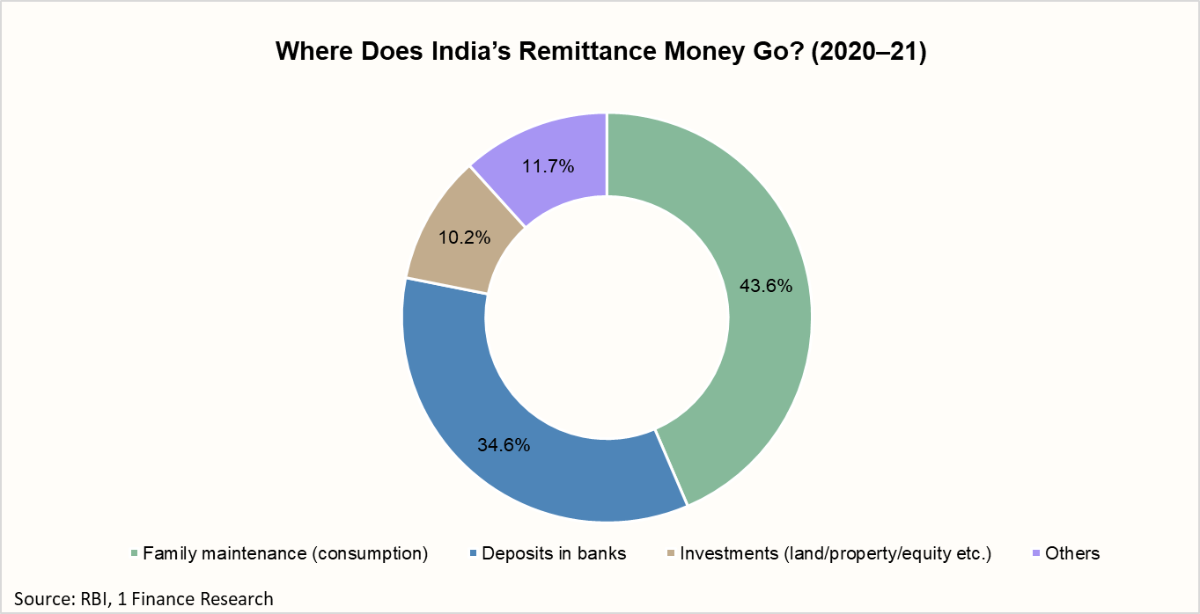
There is nothing inherently negative about consumption; remittances help families pay for food, healthcare, education and housing, while reducing their dependence on debt. The macro limitation is that consumption supports demand today, while productive investment expands the economy’s capacity tomorrow. If only a small share of remittances flows into businesses, financial assets or productive capital, India may be capturing the immediate welfare benefits of labour mobility without fully converting those overseas earnings into long-term domestic growth.
Which Indian States Depend Most on Remittances?
Remittances may be a national external buffer, but their impact is far from evenly distributed. For some states, overseas earnings form only a small addition to the economy; for others, they can be significant relative to the size of the state itself. Looking at remittances as a share of GSDP therefore tells us much more about which states are actually dependent on money earned abroad than absolute remittance receipts alone.
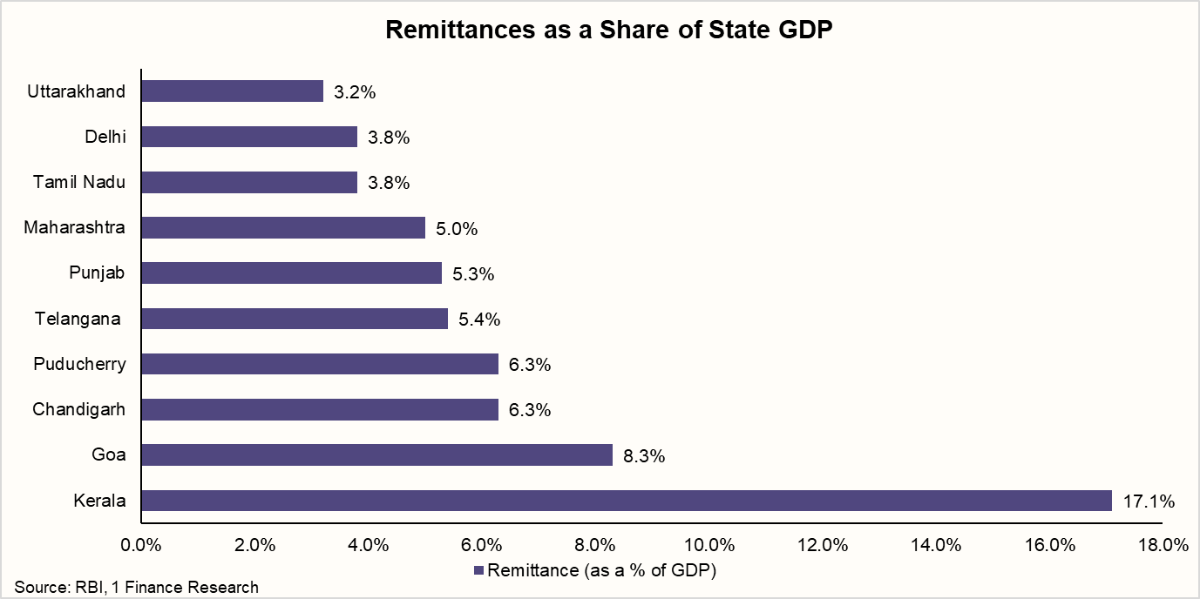
| 💡Kerala’s dependence on remittances is closely tied to its long history of overseas migration. Around 22 lakh Keralites are estimated to live abroad, with the Gulf remaining a major destination. This large overseas workforce helps explain why remittances have become such an outsized part of Kerala’s economy, equivalent to around 17% of state GDP in our analysis. |
The dependence on remittances looks very different across states. For most major recipients, remittances are equivalent to around 3 - 6% of state GDP, but Kerala stands out sharply at 17.1%. This means overseas earnings are not just supporting individual households in Kerala; they have become a significant part of the state’s economic story. The contrast also shows why looking only at absolute remittance inflows can be misleading: what matters is how large those flows are relative to the size of the local economy.
| 💡Kerala Has High Remittances but Limited Productive Capacity Kerala is the clear outlier, with remittances equivalent to around 17% of state GDP. These flows have supported household incomes, consumption, housing, education and better living standards. Yet Kerala is not among India’s major industrial powerhouses, despite decades of large overseas inflows. This brings us back to the consumption-investment divide: large remittances can make households wealthier and support the local economy without necessarily creating factories, businesses or productive capacity at the same scale. The Kerala story shows that receiving remittances and converting them into long-term productive growth are two very different things. |
Can India Sustain Its Labour Export Model?
India’s labour-remittance engine looks strong today, but it cannot be taken for granted. The same countries that need foreign workers are also becoming more selective about who they allow in, what skills they need and how long migrants can stay.
| What Could Disrupt India's Labour Export Model? | |
|---|---|
| Risk | Why it Matters for India |
| Tighter immigration rules | Countries such as the UK, Australia, Canada, New Zealand and the US are becoming more selective on migration, which could narrow some traditional pathways. |
| H-1B & skilled-visa uncertainty | Changes to US skilled-worker rules can directly affect one of India's most important high-skilled migration corridors. |
| Gulf localisation | Policies such as Saudisation increasingly prioritise local workers, potentially reducing opportunities for expatriates in some occupations. |
| AI & automation | Some IT, services and routine jobs that currently employ Indian workers abroad could face disruption. |
| Brain drain | Losing doctors, engineers, researchers and other highly skilled workers can create shortages at home even while generating remittances. |
| Destination concentration | Heavy dependence on a handful of countries leaves labour and remittance flows exposed to policy or economic shocks in those markets. |
So the sustainability of India’s labour-export model will depend on more than having a large working-age population. India will need to continuously upgrade skills, diversify destination markets and move workers towards occupations where global shortages are strongest. And ultimately, the value of this model will depend not only on how many Indians work abroad, but on how much of the income, skills and knowledge they generate abroad is converted into productive capacity at home.
| 💡Migration does not always mean a permanent loss of talent. Workers can return with capital, skills, international experience and professional networks, turning brain drain into brain circulation. The real challenge for India is creating enough opportunities at home to put that returning knowledge and capital to productive use. |
Do Remittances Benefit the Indian Economy?
After looking at the entire chain, from workers leaving India to remittances coming home, the answer is yes, but with an important caveat.
Labour mobility has clearly benefited India. It creates employment opportunities, raises household incomes and brings in a large and relatively stable stream of foreign exchange. Remittances also support India’s current account and provide a cushion when foreign capital flows turn volatile. But the long-term payoff is less straightforward. If a large share of these earnings continues to support consumption and deposits rather than productive investment, India may be capturing the income benefits of labour mobility without fully capturing its growth potential.
| Does Labour Mobility Benefit India? | ||
|---|---|---|
| Dimension | How It Affects India's Labour Mobility | Assessment |
| Household income & welfare | Overseas earnings raise household incomes and provide financial support to migrant families. | Strong positive |
| Consumption & living standards | Remittances support spending on everyday needs, housing, healthcare and education. | Strong positive |
| Foreign exchange inflows | Remittances provide a large and relatively stable source of foreign currency. | Strong positive |
| Current account support | Remittance inflows help offset deficits elsewhere in the current account and reduce external financing pressure. | Strong positive |
| Employment opportunities | Overseas markets absorb part of India's large workforce and provide access to jobs that may offer higher earnings. | Positive |
| Skill development & global exposure | Migrants can acquire international skills, experience and networks that may benefit India if they return or remain economically connected. | Positive, but uneven |
| Brain drain | Migration creates opportunities and remittances, but the loss of doctors, engineers and other skilled workers can create domestic shortages. | Mixed |
| Productive investment from remittances | A relatively small share of remittances goes directly into productive investments, limiting their ability to create future income and jobs. | Limited |
| Long-term growth impact | Labour mobility has greater long-term value if overseas earnings, skills and knowledge are converted into domestic investment and productivity. | Depends on how remittances are used |
India has already built one of the world’s largest labour-remittance engines. The next challenge is not simply to send more workers abroad or receive more money from them; it is to extract more long-term economic value from that mobility. That means moving workers towards higher-value skills while creating better channels at home for their earnings, experience and knowledge to flow into businesses and productive assets. As the world ages, India’s people could become one of its greatest economic exports. Whether that becomes a lasting competitive advantage will depend on how effectively India turns global earnings into domestic productivity.