The oil and gas sector remains a cornerstone of the global economy, powering transportation, industries, households, and economic activity. For India, which imports nearly 90% of its crude oil requirements, the sector plays a critical role in shaping inflation, trade balances, energy security, and overall economic growth.
Recent geopolitical tensions, including the Russia–Ukraine war and conflicts in the Middle East, have highlighted the sector's vulnerability to supply disruptions and price volatility. Combined with factors such as exchange rate movements, domestic demand, government policies, and refining margins, these developments continue to influence the outlook for India's energy market.
This report examines the key drivers of the oil and gas sector, the impact of recent global events, and the opportunities and risks likely to shape its performance in the coming quarters.
Key Drivers and Risks of the Oil and Gas Sector
India's oil & gas sector is supported by strong domestic demand, economic activity and moderating crude prices, but the outlook remains exposed to significant external risks. Geopolitical tensions, India's dependence on imported crude, currency movements and the gradual shift towards cleaner energy will continue to shape the sector's trajectory. The balance between these supporting factors and emerging risks points to a cautiously positive outlook for the coming quarters.
Overall Outlook: 🟡Cautiously Positive
| Oil & Gas Sector Outlook Dashboard | ||
|---|---|---|
| Factor | Current Assessment | What to Watch |
| Crude Oil Prices | 🟢Supportive | OPEC+ supply, global demand, geopolitical disruptions |
| Petroleum Product Demand | 🟢Strong | Transportation, industrial activity, aviation and LPG demand |
| USD/INR | 🟡Mixed | Rupee depreciation could offset benefits of lower crude prices |
| Industrial Activity | 🟢Supportive | IIP, manufacturing activity and infrastructure spending |
| Domestic Natural Gas Production | 🟡Mixed | Production growth, new fields and LNG import dependence |
| Geopolitical Risk | 🔴High | Middle East tensions, Strait of Hormuz, sanctions and shipping |
| Energy Transition | 🟡Mixed | EV adoption, renewables, ethanol, hydrogen and gas demand |
What does this mean for the sector?
India's oil & gas sector is likely to remain supported by strong domestic demand and relatively manageable crude prices in the near term. However, the outlook is not without risks. A geopolitical supply shock or continued rupee depreciation could quickly increase import costs, while rising EV adoption will gradually change the composition of petroleum demand. The sector's near-term trajectory therefore looks resilient, but its longer-term growth will increasingly depend on supply diversification, domestic production and adaptation to the energy transition.
India's Growing Energy Demand and Oil Dependence
India's oil and gas sector sits at the centre of the country's growth story. As the world's third-largest crude oil consumer, India's expanding economy, rising mobility, urbanisation and industrialisation are steadily increasing its energy requirements. Yet, the country's ability to meet this demand remains heavily dependent on global markets, with around 89% of its crude oil supply coming from imports in FY26.
| India's Crude Oil Imports vs Domestic Production (FY26) | |
|---|---|
| Crude Oil Domestic Production | Crude Oil Imports |
| 29 MMT | 246 MMT |
This creates a structural tension for the sector: demand is becoming increasingly domestic and growth-driven, while supply remains externally exposed. Petroleum consumption has remained resilient even through periods of sharp crude-price volatility, suggesting that transportation, industrial activity, aviation and household fuel requirements are stronger drivers of demand than short-term price movements. Petroleum Product consumption reached around 243 MMT in FY26 from 239 MMT in FY25, reinforcing the strength of the underlying demand base.
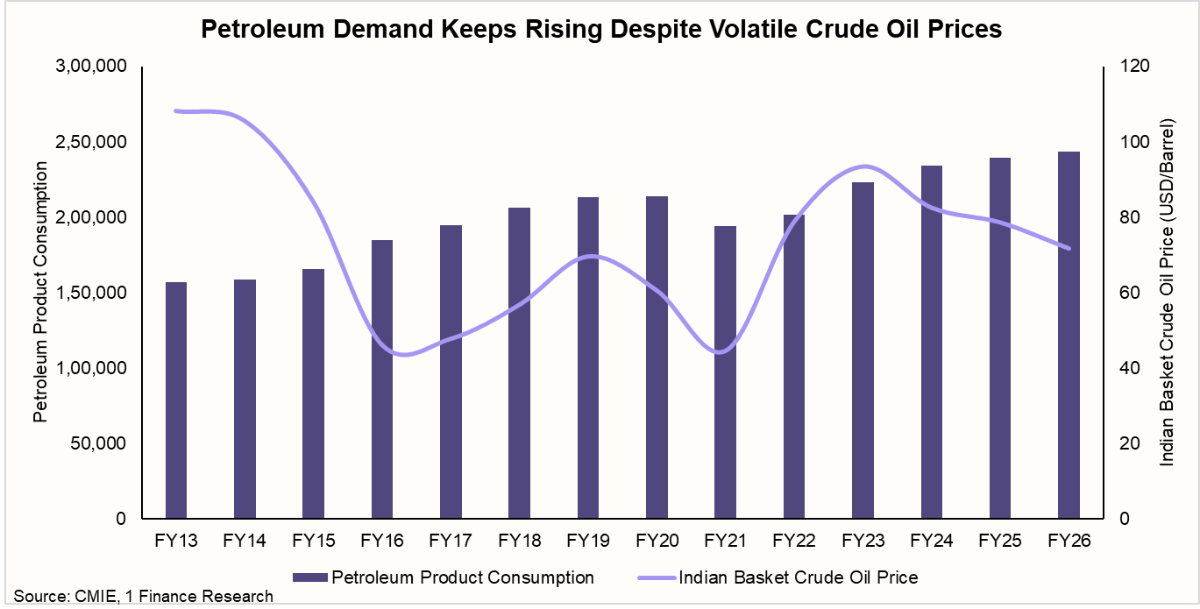
Petroleum product consumption has risen steadily despite significant fluctuations in crude prices, highlighting the strength of India's underlying energy demand. Consumption has continued to expand even as crude prices moved sharply higher and lower, suggesting that economic activity, mobility and industrialisation are stronger drivers of demand than short-term oil-price movements. This resilience is likely to continue, although the composition of demand will gradually evolve with the energy transition.
Recommended for you
Readers also explored
The Gulf Shock and India’s Energy Reality
 6 min read

Currency in Circulation: How Much Money Exists in the World?
9 min read
The key question going forward is therefore not whether India's oil demand will grow, but how sustainably it can grow and at what cost. Continued economic expansion should support consumption, particularly across freight, aviation and industry. At the same time, India's high import dependence leaves the sector exposed to crude-price shocks, geopolitical disruptions and rupee depreciation. This makes global oil prices, domestic economic activity and India's ability to diversify its energy supply critical determinants of the sector's outlook.
What Drives India's Petroleum Demand?
India's petroleum demand is increasingly tied to the expansion of economic activity and mobility rather than short-term movements in crude prices. Transportation remains the largest source of demand, supported by rising vehicle ownership, freight movement and aviation. Industrial activity is another important driver, with manufacturing, construction and petrochemicals relying on petroleum products as both fuels and feedstocks. Household demand, primarily through LPG, provides a relatively stable base.
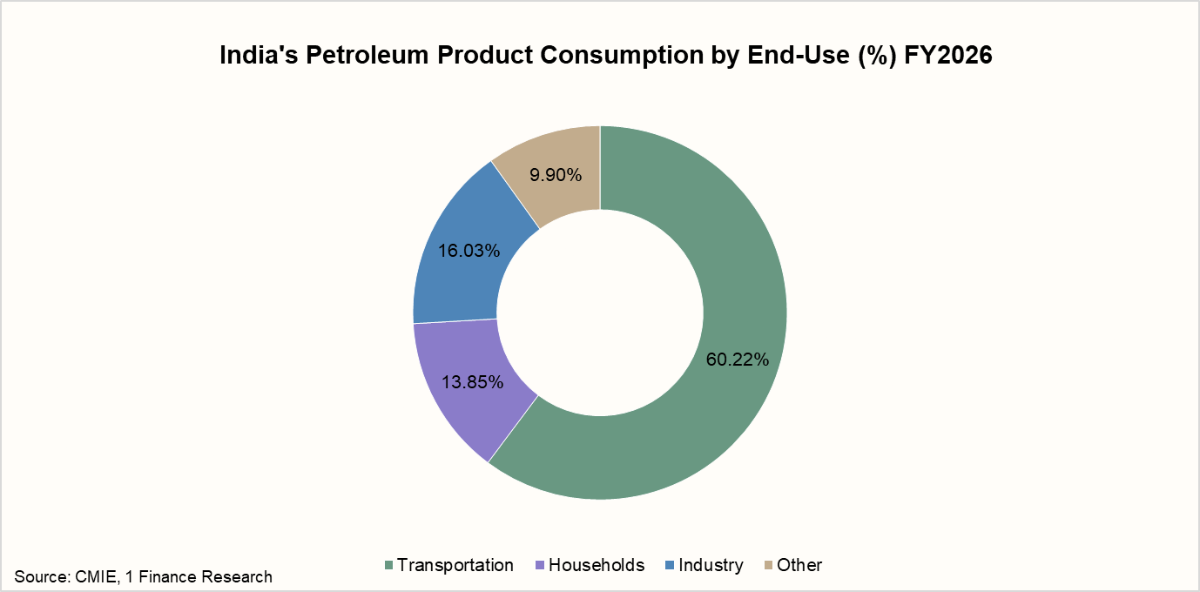
The composition of demand, however, is likely to evolve. Freight, aviation and industrial activity are expected to remain important sources of incremental demand, supported by infrastructure development and economic growth. At the same time, EV adoption and greater fuel efficiency could gradually moderate petrol demand, particularly in passenger vehicles and two-wheelers. This means India's total petroleum demand can continue to grow even as the sources of that growth shift across sectors.
The key indicator to watch is therefore not just total consumption, but where the next unit of demand comes from. A sustained rise in industrial output, freight movement and air travel would strengthen the demand outlook, while faster EV adoption or a slowdown in economic activity could change its trajectory.
Key Macroeconomic Factors to Watch
With demand remaining structurally strong, the next question is what could accelerate or weaken that growth from here. Five indicators provide a useful read on the sector's near-term direction: crude oil prices, the USD/INR exchange rate, petroleum consumption, industrial activity and domestic natural gas production. Together, they capture the sector's cost pressures, demand conditions and domestic supply outlook.
| Key Macroeconomic Indicators Shaping India's Oil & Gas Sector | |||
|---|---|---|---|
| Assessment | Macroeconomic Factor | Value | 1Y trend |
| 🟢 | Indian Basket Crude Oil Price | $82/barrel |  |
| 🟡 | USD/INR Exchange Rate | ₹95.82/US$ |  |
| 🟢 | Petroleum Product Consumption | 19.4 million tonnes |  |
| 🟢 | Industrial Output - Refining and petroleum products (IIP) | 23.8 million tonnes |  |
| 🟡 | Domestic Natural Gas Production | 2759 million cu. metres |  |
1. Crude Oil Prices
The Indian Basket crude oil price has steadily moderated from US$93.4/barrel in FY23 to US$82.5 in FY24, US$78.6 in FY25 and US$71.7 in FY26. The decline reflected softer global demand expectations, improved supply conditions and higher production outside OPEC+, although geopolitical disruptions periodically pushed prices higher.
The key question now is whether this relatively favourable price environment can persist. Our base case is for crude prices to remain broadly manageable, but with significant upside risks. Slower global growth could keep prices contained, while OPEC+ supply decisions or an escalation of Middle East tensions could quickly push prices higher. For India, the difference is significant: lower crude supports the import bill and downstream margins, while a sustained move above US$85–100/barrel would begin to reverse these benefits and put renewed pressure on inflation and the rupee.
2. USD/INR Exchange Rate
The rupee has remained under pressure, with the USD/INR moving from around ₹88 to nearly ₹96 per US$ over the past year. This has limited the benefit India gets from softer global crude prices, as every dollar spent on oil translates into more rupees when the domestic currency weakens.
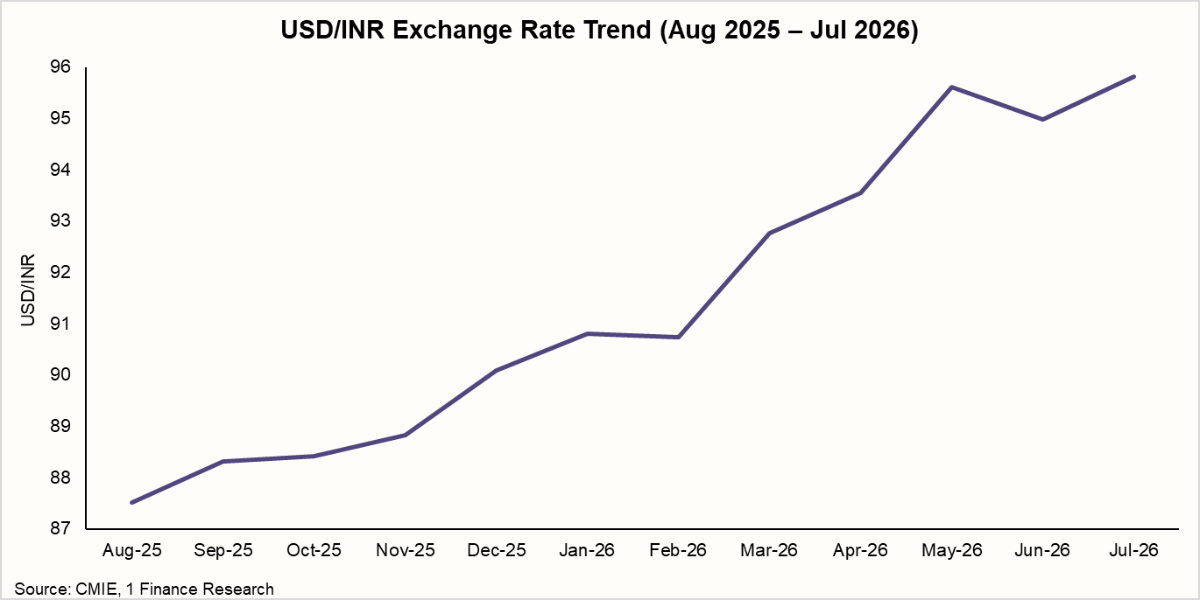
From here, the exchange rate will be an important swing factor for India's oil import costs. If the rupee stabilises while crude remains around current levels, the combination would provide meaningful relief to the import bill and inflation. However, continued depreciation could offset much of the benefit from lower crude prices and keep pressure on the current account and fuel-related costs. The key risk is therefore not crude prices alone, but the interaction between crude and the rupee.
3. Petroleum Product Consumption
India's petroleum demand remained resilient through FY26, with monthly consumption ranging from 23.1 million tonnes in September 2025 to 26.1 million tonnes in December 2025, and total consumption reaching around 295.3 MMT for the year. This strength has been supported by transportation activity, industrial production, aviation and household LPG demand.
The more important question is whether this momentum can continue. The underlying demand drivers remain favourable, particularly rising mobility, freight movement, infrastructure activity and air travel. However, the pace of growth could moderate if industrial activity slows or if faster EV adoption begins to displace petrol demand. The near-term outlook therefore remains positive, with the composition of demand likely to matter increasingly as much as its overall growth.
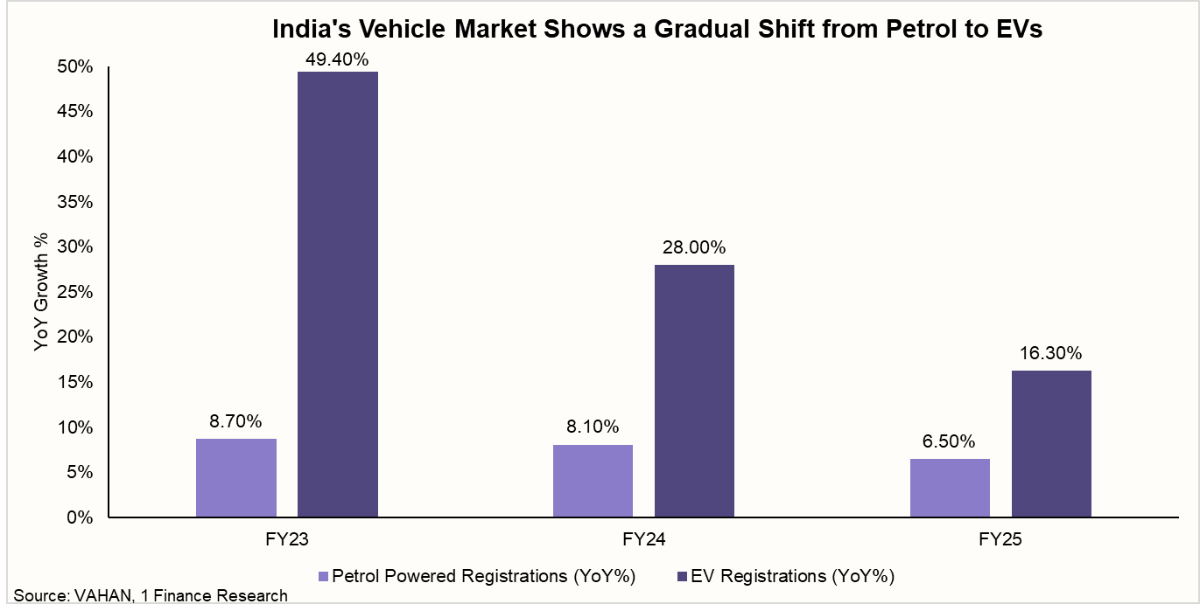
Petrol-powered vehicle registrations continued to grow, but their YoY growth slowed from 8.7% in FY23 to 6.5% in FY25, while EV registrations, despite moderating, continued to grow much faster at 16.3% in FY25. This points to a gradual shift in the transport fuel mix, with EV adoption likely to place increasing pressure on petrol demand over time. However, diesel, aviation fuel and industrial petroleum demand are expected to remain key drivers of overall consumption, allowing India's petroleum demand to stay resilient even as transportation becomes increasingly electrified.
4. Industrial Output (IIP)
Industrial activity has remained supportive of India's energy demand, with IIP growth reaching 5.1% YoY in May 2026. Strong manufacturing, infrastructure spending and domestic demand have helped sustain industrial momentum, supporting demand for diesel, furnace oil, naphtha and natural gas.
The outlook for industrial activity remains an important support for petroleum demand, particularly as manufacturing and infrastructure investment deepen. However, a slowdown in domestic or global demand could moderate industrial fuel consumption. IIP will therefore be an important indicator of whether the current strength in energy demand can be sustained.
5. Domestic Natural Gas Production
Domestic natural gas production has softened, falling from 2,908.3 million cubic metres in April 2025 to 2,759.4 million cubic metres in June 2026. This comes as gas demand from fertilisers, industry, power and city gas distribution continues to expand, increasing the potential gap between domestic supply and demand.
The key question is whether new domestic production can reverse this decline. If new fields and capacity additions fall short, greater reliance on imported LNG could expose India to global gas prices and currency movements. A recovery in domestic output, however, would strengthen energy security and reduce import dependence.
How Geopolitical Tensions Affect India's Oil & Gas Sector
Geopolitical tensions remain a major risk for India's oil and gas sector, particularly with recent tensions around Iran and the Strait of Hormuz threatening global oil and LNG flows. Any prolonged disruption could push up crude, freight and insurance costs, quickly increasing India's import bill.
India has taken steps to reduce its exposure, including diversifying crude suppliers and building Strategic Petroleum Reserves (SPRs) to provide a buffer during supply disruptions. However, these reserves cover only a fraction of India's overall consumption, so they cannot fully shield the country from a prolonged shock.
The key risk remains an extended disruption around the Strait of Hormuz, which could reverse the benefit of lower crude prices and put pressure on India's inflation, current account and rupee. Further supplier diversification and expanding strategic reserves will therefore remain important for strengthening India's energy security.
| India has diversified its sources of crude, but it has not yet built enough of a strategic buffer to eliminate its exposure to a major global supply disruption. A prolonged disruption around the Strait of Hormuz could therefore quickly translate into higher crude prices, a larger import bill, rupee pressure and higher inflation. |
What to Watch
- Iran - Middle East tensions and their escalation
- Security and accessibility of the Strait of Hormuz
- OPEC+ production decisions
- Sanctions and changes in Russian oil trade
- Shipping, freight and insurance costs
- India's strategic petroleum reserves and crude sourcing diversification
Impact of Crude Oil Prices on India's Key Sectors and Markets
A change in crude oil prices does not affect every part of the energy ecosystem in the same way. The impact depends on whether a company produces crude, refines it, markets petroleum products, or consumes oil as a major input. Understanding these linkages is therefore important when assessing the investment implications of an oil-price shock.
| Crude Oil Price Impact on Indian Industries and Markets | ||||
|---|---|---|---|---|
| Scenario | Potential Winners | Potential Losers | Why? | What to Expect |
| Crude prices rise sharply | Upstream producers (ONGC, Oil India) | OMCs, aviation, paints, tyres, chemicals (Indian Oil, BPCL, IndiGo, Asian Paints, MRF) | Producers benefit from higher realisations, while oil-intensive businesses face higher input costs. | Upstream margins improve; oil-intensive sectors face pressure |
| Crude prices fall | OMCs, aviation, paints, tyres, chemicals (Indian Oil, BPCL, HPCL, IndiGo, Asian Paints, MRF) | Upstream producers (ONGC, Oil India) | Lower crude reduces input costs for consumers and can improve refining/marketing economics, while producers receive lower realisations. | Positive for downstream users; supports margins and consumption |
| Refining margins rise | Refiners (Reliance Industries, Indian Oil, BPCL, HPCL) | - | Higher spreads between crude input costs and refined product prices improve refinery profitability. | Refiners could outperform if product demand remains strong |
| Rupee depreciates sharply | Export-oriented refiners (potentially) (Reliance Industries) | Import-dependent OMCs, oil consumers (Indian Oil, BPCL, HPCL, IndiGo) | A weaker rupee raises the rupee cost of imported crude and other energy inputs. | Could offset benefits of lower crude |
| Geopolitical supply disruption | Domestic producers; potentially alternative suppliers (ONGC, Oil India) | Refiners, OMCs, airlines and oil-intensive industries (Indian Oil, BPCL, HPCL, IndiGo) | Supply shortages can raise crude, freight and insurance costs. | Broad-based margin and inflationary pressure |
The table shows the direction of impact, but the key takeaway is that crude price movements do not affect all businesses uniformly. Companies with direct exposure to crude prices, such as upstream producers, respond differently from refiners and OMCs, while fuel-intensive sectors such as aviation, paints and tyres face higher input costs when prices rise. The extent of the impact also depends on pricing power, refining margins, inventory levels and the ability to pass higher costs to consumers. Thus, for investors, the same oil-price shock can create both opportunities and risks across different sectors.
💡What happens to India if crude prices move sharply from here?
| ||||||||||||||||||
| 💡Base Case: We expect the Indian Basket crude price to remain broadly in the $70–85/barrel range through Q3 FY27, with significant upside risk if tensions around the Strait of Hormuz escalate. |
India's vulnerability rises sharply when higher crude prices coincide with a weaker rupee. A supply disruption that pushes Brent above $100/barrel, combined with rupee depreciation, could significantly increase the cost of India's energy imports. Conversely, lower crude prices would provide relief to inflation and the current account while supporting domestic consumption.
Conclusion
India's oil and gas sector enters the coming quarters on a cautiously positive footing. Strong domestic petroleum demand, strong industrial activity, and moderating crude oil prices provide a supportive backdrop. However, India's high import dependence leaves the sector vulnerable to a weaker rupee, supply disruptions, and geopolitical shocks, particularly in the Middle East and around the Strait of Hormuz.
Over the longer term, the sector will also have to look after India's energy transition as EVs, renewables, biofuels and green hydrogen expand. Yet, with oil and gas continuing to play a central role in transportation, industry, households and petrochemicals, demand is unlikely to disappear in the near term. The key for India's energy outlook will be balancing rising energy needs with greater supply diversification, stronger domestic production and a gradual transition towards cleaner sources.